Why Some Dogs Greet With a Toy Instead of a Tail Wag
Some dogs do not just wag at the door. They sprint for a stuffed duck, parade a tennis ball through the hallway, or greet their people with a squeaky toy clenched proudly in their mouth. That ritual often reflects excitement, self-control, and a learned social routine more than a simple invitation to play.
Avery writes about trends, platforms, and strategic shifts in pets & animal lifestyle, with attention to what matters in practice.
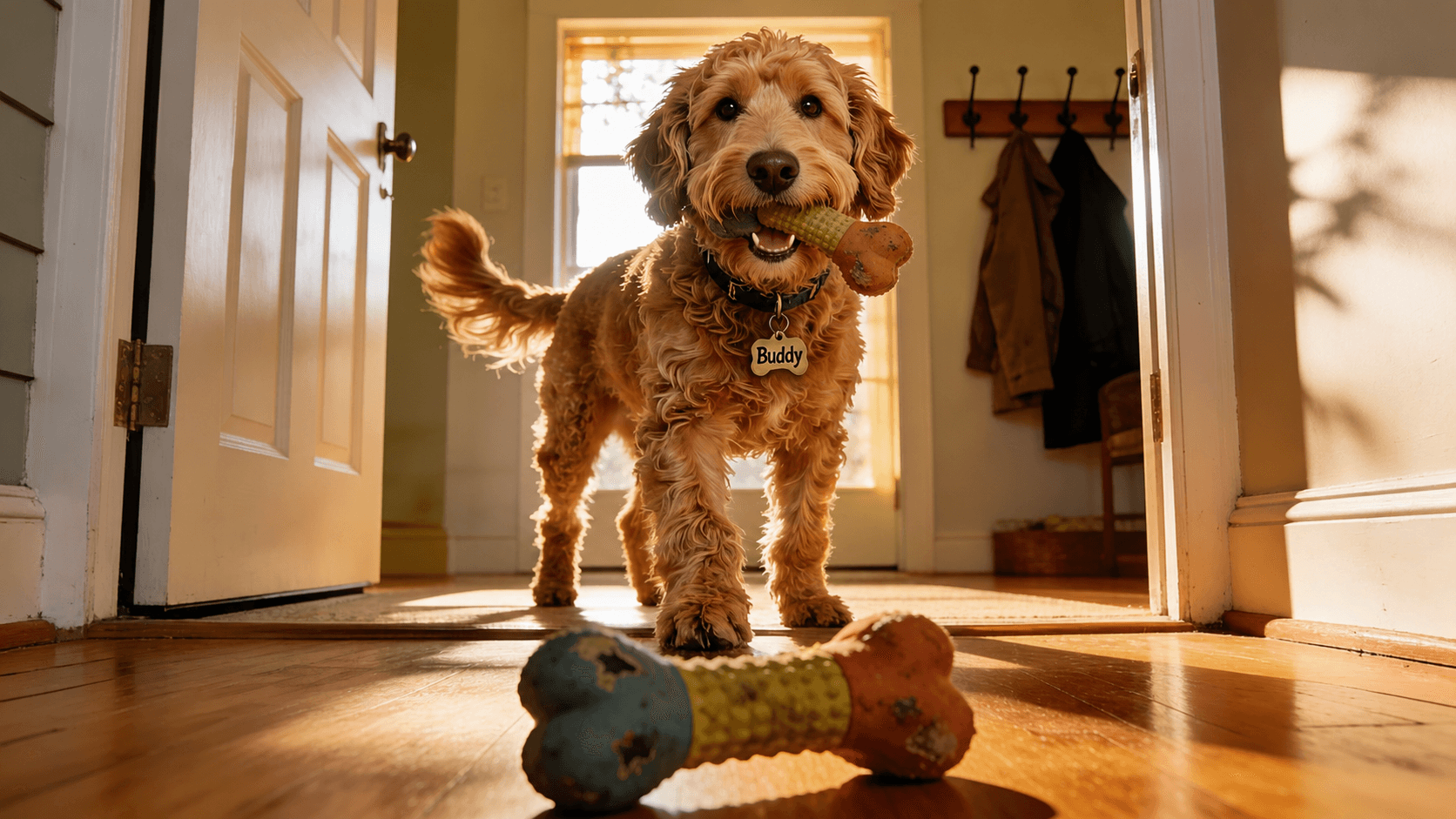
Some of the warmest dog greetings come with a toy attached. The front door opens, and instead of leaping, barking, or spinning in circles, a dog rushes off, grabs a plush fox, and returns looking almost ceremonial about it. It is easy to read that as random silliness, but for many dogs, toy-carrying is a meaningful part of how they handle reunion energy.
A dog arriving at the door with a toy is often doing three things at once: expressing excitement, regulating that excitement, and participating in a household ritual that has become rewarding over time. The behavior can look comic, but it is often surprisingly sophisticated.
The toy is doing emotional work
When dogs get excited, they need somewhere for that energy to go. Some channel it into jumping. Some bark. Some zoom around the room. Others pick up an object.
Holding a toy can help organize that burst of emotion. A mouth full of stuffed giraffe makes it harder to nip sleeves, bark nonstop, or ricochet off furniture. In that sense, the toy acts like a pressure valve. The dog is still thrilled, but the excitement is being carried in a more controlled way.
This is especially common in dogs that already like carrying things. Retrievers, spaniels, and many mixed-breed dogs with soft-mouth tendencies often seem naturally drawn to grabbing an object when aroused. That does not mean every toy-bearing greeting is about breeding, but inherited tendencies can shape how a dog expresses big feelings.
There is also a social element. Dogs often use objects during interaction: inviting play bows, carrying prized items near people, or trotting around with something while monitoring human reactions. At the door, the toy can function like a social offering. Not a gift in the human sense, exactly, but a way of saying, "I am excited you are here, and this object is now part of the moment."
Why one dog grabs a toy and another just wags
Not all enthusiastic dogs greet the same way, because greeting behavior is a mix of temperament, learning, and logistics.
Personality matters
Some dogs are physical and object-focused. They love carrying, chewing, presenting, and parading possessions around the house. Others are more body-language driven and express excitement through wiggling, leaning, or vocalizing instead. A toy greeting is often just one version of an outgoing social style.
Breed tendencies can nudge the behavior
Dogs bred to retrieve or carry may be more likely to reach for an object under excitement. Labrador Retrievers, Golden Retrievers, Flat-Coated Retrievers, and many sporting mixes often show this pattern, though it is hardly exclusive to them. Herding breeds may also grab toys during high arousal, especially if they are used to channeling energy through mouth-oriented play.
Still, breed is not destiny. Plenty of retrievers never do this, and plenty of terriers or mixed breeds become devoted toy greeters.
Owners accidentally teach it
This is a major reason the ritual sticks. A dog grabs a toy once, people laugh, praise, crouch down, and greet enthusiastically. The dog learns that returning with a plush moose makes homecoming even better.
Over time, the sequence becomes predictable:
1. Person arrives. 2. Dog feels excitement. 3. Dog grabs toy. 4. Dog gets attention.
That is a powerful loop. Dogs are excellent observers of patterns, especially around high-value daily events like departures and reunions.
The environment shapes the habit
Some dogs have easy access to toys near the entryway, making the behavior simple to repeat. In other homes, the nearest available object might be a sock, slipper, or child’s stuffed animal. The ritual is often less about the specific item and more about the need to hold something during the greeting.
It does not always mean “play with me right now”
A common misunderstanding is that a toy in the mouth automatically means the dog is demanding an immediate game of fetch. Sometimes that is true. Many dogs absolutely hope the reunion will turn into tug, chase, or squeaky chaos.
But often the toy is more like an emotional accessory than a formal invitation. The dog may simply want to pace with it, squeak it a few times, lean against you, or show it off while wagging. Some dogs seem almost too excited to play in a focused way during the first minute home. They need to settle into the reunion before they can decide what happens next.
That is why context matters. If your dog drops the toy at your feet and stares expectantly, play is probably on the agenda. If your dog carries it in circles, does a full-body wiggle, and then heads to the couch, the object was likely part of the greeting itself.
This distinction can help owners respond better. You do not need to turn every toy greeting into a rowdy session if your dog is mostly using the object to self-regulate. Sometimes calm praise, petting, or a brief acknowledgment is exactly what the dog wanted.
How households turn a quirky habit into a ritual
Dogs thrive on repeated social patterns, and arrival routines are some of the strongest. The same time of day, the same sound of keys, the same footsteps in the hall, the same reaction from family members: all of that builds expectation.
If your dog has learned that coming home triggers a burst of emotional intensity, a toy can become the centerpiece of that script. Many owners unknowingly strengthen the behavior by making it feel special.
That is not a bad thing. In fact, a toy-carrying greeting is often a charming compromise between uncontained excitement and polished self-control. It can be far easier to live with than door-launching, frantic mouthing, or shrill barking.
You can support the ritual by making it easy to succeed:
Keep a few safe, durable toys near the door.
Reward the dog for grabbing those items instead of clothing or shoes.
Greet calmly if your goal is to lower overall excitement.
Avoid turning every arrival into a high-intensity event if your dog struggles to settle.
Many dogs rise to the level of the routine they practice. If the household greeting is loud and chaotic, the dog may escalate. If the routine includes fetching a designated toy and receiving calm affection, the toy becomes part of a stable, pleasant pattern.
When the behavior is sweet, and when it needs redirecting
Most toy greetings are harmless and delightful. They are usually a sign that a dog has found a socially acceptable way to manage excitement and connect with people.
It is worth stepping in, though, if the dog is grabbing unsafe or inappropriate objects. Shoes, remote controls, eyeglasses, children’s toys, and anything small enough to swallow can quickly turn a cute habit into a household problem.
The best fix is usually redirection, not punishment. If you know your dog tends to grab something when the door opens, place a preferred toy by the entrance and encourage that choice before bad habits take root. Many dogs are happy to substitute if the approved item is easy to find and has a strong positive history.
You can also rehearse low-key arrivals. Walk in, pause, ask for a sit if your dog knows one, and praise when the dog chooses the toy. The goal is not to erase the personality from the greeting. It is to make the ritual safer and more predictable.
If the behavior looks frantic rather than joyful, or if it comes with hard panting, spinning, destructive grabbing, or inability to calm down after several minutes, the issue may be broader overarousal rather than a simple toy habit. In those cases, reducing the intensity of departures and arrivals can help.
The charming part of the toy greeting is that it often reflects a dog trying to be good while being wildly happy. A stuffed animal in the mouth may be the dog’s version of keeping it together. For many owners, that parade down the hallway with a favorite toy is more than a quirk. It is a homecoming ritual the dog built, practiced, and now proudly performs every time the important people return.
Safety & Scope
This article is for general informational purposes and does not replace professional advice for complex repairs or installations.
Frequently Asked Questions
+Why does my dog bring me a toy every time I come home?
Usually because your dog has linked your arrival with excitement and uses the toy to channel that energy. The toy may also be part of a learned greeting ritual that gets attention and praise.
+Is carrying a toy a sign my dog wants to play immediately?
Sometimes, but not always. Some dogs are inviting play, while others are simply using the toy to manage excitement and participate in the greeting. Look at the rest of the body language to tell the difference.
+How do I stop my dog from grabbing shoes instead of a toy?
Keep approved toys near the door and make them the easiest option. Reward your dog for choosing those items, limit access to shoes, and practice calm arrivals so the greeting does not escalate into frantic grabbing.