Why Pets Love Fresh Laundry More Than Their Own Beds
A heap of clean clothes can outcompete an expensive pet bed for simple reasons: warmth, familiar scent, soft texture, and the feeling of being close to the people pets trust most.
Jordan specializes in turning complex pets & animal lifestyle topics into clear, useful explainers for everyday readers.
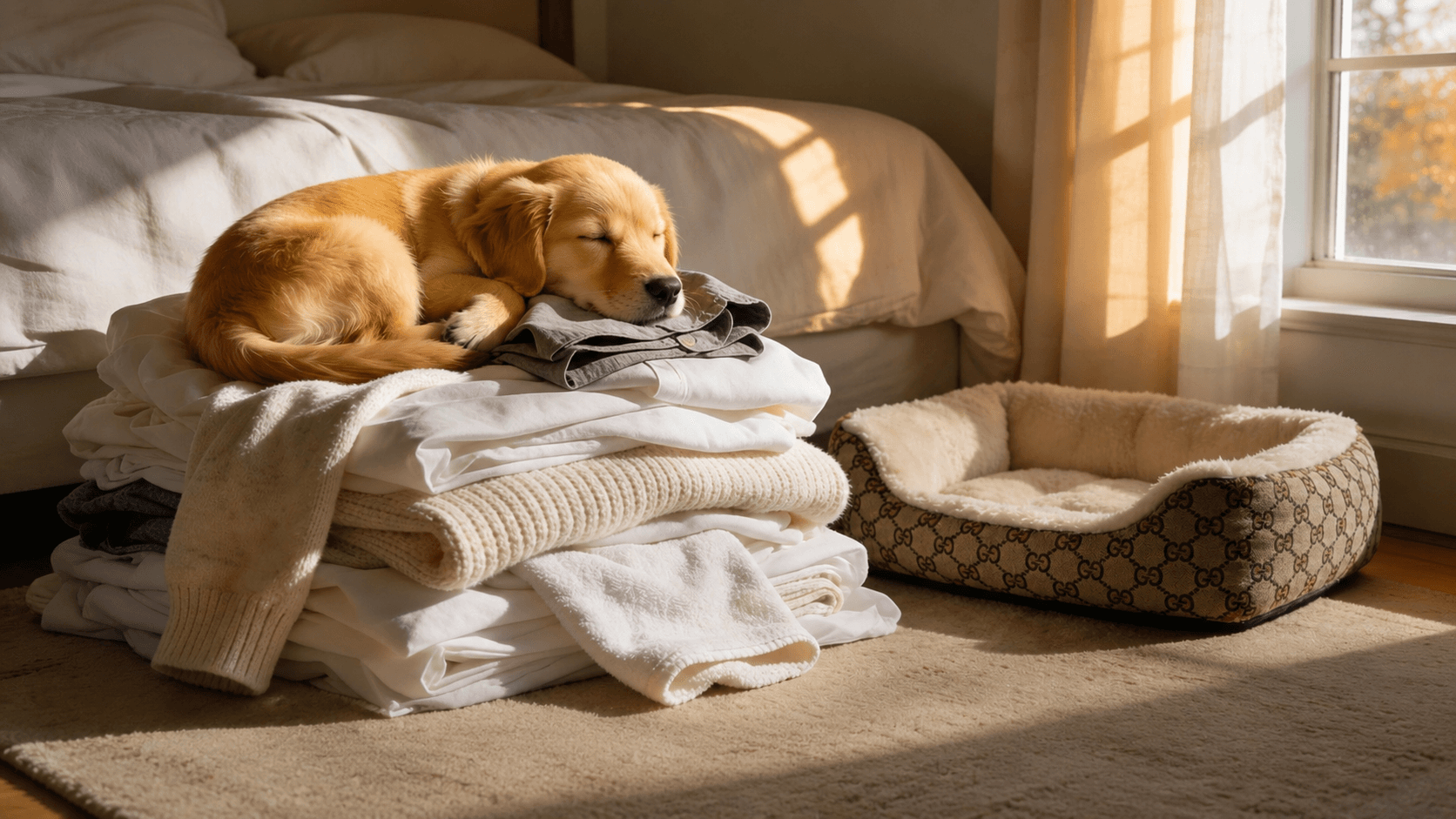
Fresh laundry has an almost unfair advantage over most pet furniture. To a person, a clean pile of shirts or towels looks like a chore waiting to be finished. To a pet, it can look like the best seat in the house: warm, soft, heavily scented with familiar people, and temporarily elevated in value precisely because it is new.
That is why cats curl up in baskets of folded towels and dogs sprawl across freshly dried hoodies they ignored when those same clothes were hanging in the closet. The behavior is less about stubbornness than about comfort. Pets are responding to a bundle of cues that many store-bought beds do not replicate all at once.
Fresh laundry delivers four comforts at once
A good pet bed usually offers one or two things well: cushioning, perhaps, or a plush cover. Fresh laundry often delivers four comforts simultaneously.
Warmth is the most obvious. Clothes coming out of the dryer retain heat, and even after cooling, they often stay warmer than a floor-level bed. Many pets, especially cats and short-haired dogs, actively seek pockets of retained warmth. A laundry pile traps heat in layers, which makes it more inviting than a flat surface.
Softness comes next. Laundry creates a nest rather than a mattress. T-shirts, sweatshirts, towels, and sheets bunch and fold around the body. That contour can feel more secure than a bed with a fixed shape or stiff bolsters. For pets that like to knead, circle, burrow, or lean into a surface, clothing offers an instantly adjustable fit.
Scent concentration may be the most powerful factor. Clean clothes do not smell neutral to a pet. Even after washing, they still carry traces of their household: skin oils, hair, daily routines, and the distinctive scent map of the people who wear them. Detergent adds a fresh layer for humans, but a pet's nose can still detect the familiar signals underneath.
Novelty gives laundry one more edge. A bed that sits in the same corner every day becomes part of the background. A newly formed pile of laundry appears, changes shape, and then disappears. That temporary quality can make it feel special, almost like a limited-time upgrade to the usual sleeping options.
Your scent is not just familiar. It is reassuring.
Pets live in a world organized by smell far more than most people realize. For social animals, scent is not only a way to identify objects. It is a way to read safety, belonging, and emotional continuity.
That helps explain why a pet may choose a sweatshirt you wore that day over a pristine, perfectly sized bed from a pet store. Your scent carries information: where you have been, that you are nearby, and that this object belongs to the core social unit the pet depends on.
For many dogs, this is tied to attachment and routine. A shirt on the couch or a pile of warm towels in the laundry room can feel like an extension of the owner's presence. For cats, the same principle often shows up as selective napping on items with concentrated household scent, especially in moments when they want calm but still want to keep tabs on the family.
There is also a practical side to this preference. A bed bought for a pet may smell like a factory, packaging, plastic wrap, a warehouse shelf, or the car ride home. Human noses may barely register that. Pets do. If the bed never acquires enough familiar household scent, it can remain oddly impersonal compared with a pile of clothes worn, washed, and handled by trusted people.
Why the expensive bed keeps losing
Owners often assume the contest is unfair because the bed should win on comfort alone. Yet many pet beds miss what animals actually seek in a resting place.
Some beds are too exposed. If the bed is placed in a wide-open area, pets may feel visible rather than settled. A laundry pile, by contrast, is often tucked in a basket, corner, chair, or sofa edge that provides a subtle sense of cover.
Some beds are too firm or too uniform. What people interpret as supportive can feel static to a pet that wants to dig, bunch, or reshape its sleeping surface. Laundry is adaptable in a way many foam beds are not.
Some beds are in the wrong social location. A beautiful bed in a quiet spare room may lose to a laundry basket in the hallway simply because pets usually prefer to rest where life is happening. Many animals want to be near kitchen noise, footsteps, voices, and the regular traffic of the household.
And some beds simply become too predictable. Laundry piles feel high-value partly because they change. Today's stack of towels is not yesterday's stack of jeans. The shifting textures and scents can keep the spot interesting.
Laundry piles feel like social comfort zones
The appeal is not only physical. It is relational.
Pets often choose places that combine rest with connection. That is why a dog may sleep on a jacket by the front door or a cat may settle into folded clothes just brought from the bedroom. These spots are saturated with the smell of home and often located at the center of family movement.
This matters because pets do not divide their world into neat categories like people do. We think in terms of "pet bed," "laundry," and "furniture." Pets respond more directly to how a spot feels. Is it warm? Can I sink into it? Does it smell like my people? Can I watch or hear what is going on? Do I feel safe here?
A pile of clean laundry often scores well on every question.
That does not mean pets dislike their own beds. It may mean the bed offers only part of the comfort package while laundry offers the complete version. The comparison is less between "my bed" and "forbidden clothes" than between a decent resting place and an excellent one.
How to make your pet's bed a real competitor
If you would rather keep fur off fresh towels, the goal is not to scold the behavior. It is to borrow what laundry does so well.
Add familiar scent
Place a recently worn T-shirt, pillowcase, or small blanket in or over the pet's bed. This can help bridge the gap between a neutral product and a socially meaningful sleeping spot. If the bed is new, give it time to collect household scent before judging whether your pet dislikes it.
Improve the location
Move the bed closer to daily family activity. A bed in the living room, home office, or near a favorite window often gets more use than one placed where the pet feels isolated.
Match the texture your pet actually chooses
Pay attention to preferences. If your cat repeatedly sleeps on towels, a flatter, denser surface may be more appealing than fluffy faux fur. If your dog gravitates toward sweatshirts and blankets, layering soft textiles over the bed may make more sense than buying a firmer replacement.
Create a nest, not just a pad
Many pets prefer edges, folds, and contours. Add a blanket that can be rumpled, or choose a bed with sides that support curling and leaning. The ability to shape the space matters.
Use warmth strategically
In cooler months, a sunny location or a safely heated pet pad designed for animal use can make a bed much more attractive. Warmth is one of laundry's biggest advantages, so recreating it helps.
Refresh the bed without stripping away identity
Regular washing is important, but an overly aggressive cleaning routine can remove the familiar scent that makes the bed feel like home. Rotating washable covers or cleaning one layer while leaving another familiar layer in place can help some pets adjust.
The laundry habit is usually a compliment
Few household annoyances are so clearly affectionate. When pets choose clean clothes over their designated bed, they are often choosing the richest combination of warmth, softness, scent, and social reassurance available to them.
Seen that way, the habit says less about disobedience than about what comfort feels like from an animal's perspective. Fresh laundry is not magical. It just happens to combine nearly everything pets value in a resting spot, with one extra advantage many products cannot manufacture: it smells like the people they love.
Safety & Scope
This article is for general informational purposes and does not replace professional advice for complex repairs or installations.
Frequently Asked Questions
+Why does my pet sleep on clean clothes?
Clean clothes offer a combination of warmth, soft texture, familiar household scent, and a nest-like shape. For many pets, that makes laundry feel safer and more comfortable than a standard bed.
+Do pets prefer items that smell like their owners?
Many do. Familiar human scent can be calming and socially reassuring, especially for pets that like to rest near their family or on frequently used clothing and blankets.
+How can I make my pet's bed more appealing?
Add a familiar-smelling blanket or worn shirt, place the bed closer to household activity, and copy the textures your pet already prefers. Warmth and a shape that allows nesting can also make a big difference.