When Pets Reject the Expensive Bed and Choose the Floor
A pet ignoring a carefully chosen bed is usually not being stubborn. Floor spots often offer better temperature, sightlines, scent familiarity, and social proximity than the plush option humans thought looked ideal.
Avery writes about trends, platforms, and strategic shifts in pets & animal lifestyle, with attention to what matters in practice.
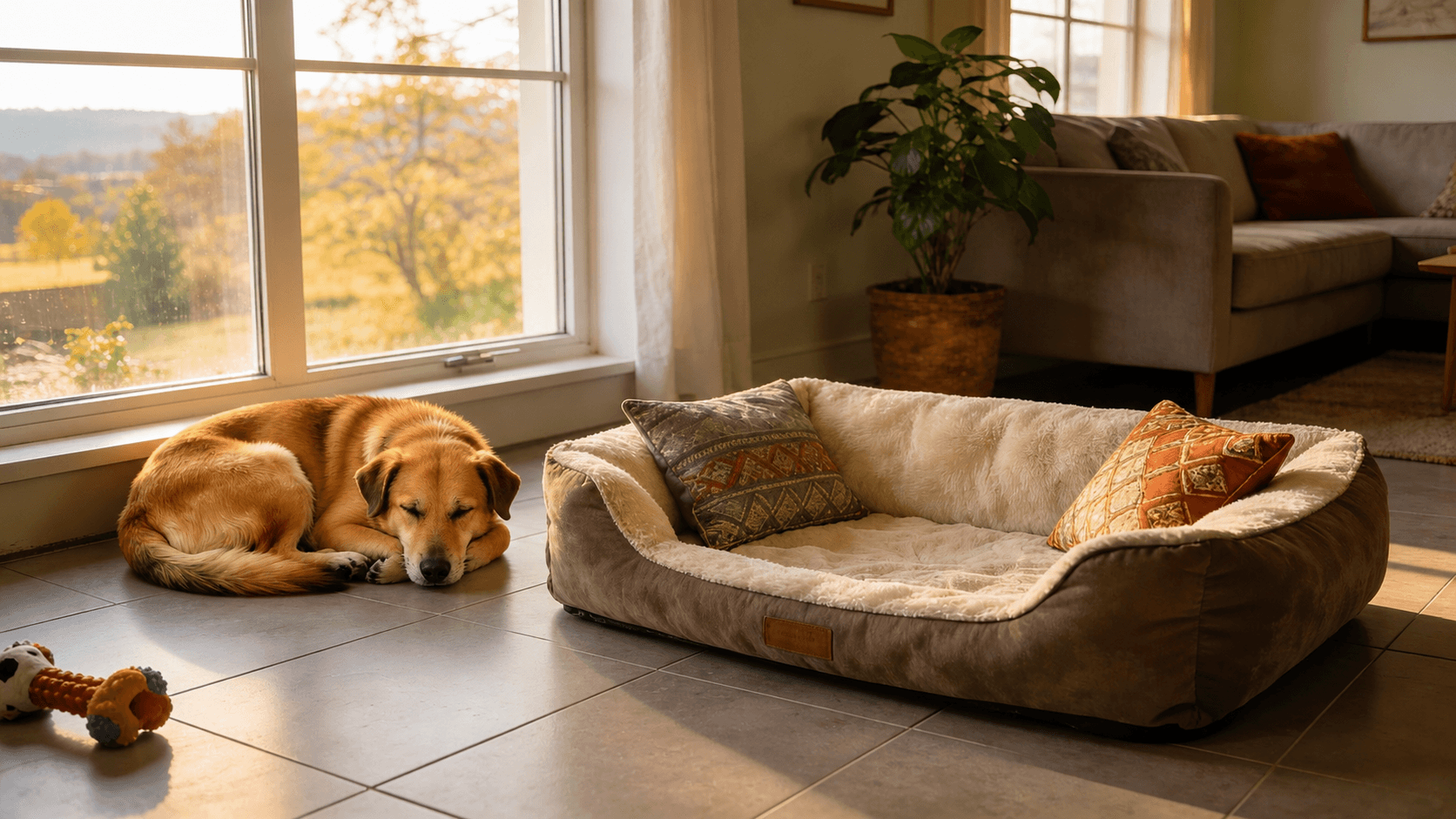
You can spend good money on a supportive memory-foam dog bed or a plush cat lounger, set it down with optimism, and then watch your pet stretch out on the kitchen tile five feet away. It feels irrational until you look at the choice from the animal’s side. Most pets are not rejecting comfort. They are selecting for a different kind of comfort than the one people tend to shop for.
The floor wins surprisingly often because it solves practical needs: staying cool, keeping watch, smelling familiar things, or remaining close to the household traffic that makes an animal feel included and informed.
The floor is often delivering something the bed does not
Many owners assume softness is the main variable. For plenty of pets, it is not even the first one.
A thick, high-sided bed can trap heat. That may be welcome in winter or for an older pet with joint stiffness, but it can be a poor fit for a double-coated dog, a long-haired cat, or any animal that naturally runs warm. Cool tile, hardwood, or even a low-pile rug can regulate body temperature better than an insulating cushion.
Then there is stability. Some soft beds shift under a pet’s weight, especially lightweight styles with overstuffed bolsters or slippery bottoms. Animals that are cautious, older, arthritic, or simply particular about footing may prefer a flat, predictable surface. What humans read as luxurious can feel unstable or awkward when turning, nesting, or standing up.
Scent matters too. A hallway runner, the spot under the dining table, or the threshold outside a bedroom all carry a dense mix of household smells. A new bed, especially one fresh from packaging, can smell synthetic, detergent-heavy, or unfamiliar. Pets often trust places that already smell like home.
Finally, the floor often offers better situational awareness. Dogs in particular may choose places where they can monitor the front door, the kitchen, and the movement of family members without having to move. Cats make similar calculations, though usually with more interest in escape routes, vertical cover, or a partially concealed angle.
Why certain random floor spots keep winning
The favorite spot is rarely random, even when it looks ridiculous.
Cool tile and hardwood
This is the most obvious case. Heat management is a major reason pets avoid plush beds. If your dog flops dramatically onto bathroom tile or your cat rotates between shady wood floors in summer, the message is clear: the bed is too warm, or the room it is in is.
Doorways and thresholds
Pets often like thresholds because they function like information hubs. From there, they can hear multiple rooms, watch people pass, and stay close to action without being in the middle of it. To humans, a doorway seems inconvenient. To a dog, it may be the perfect command center.
Under tables and beside furniture
These spots offer partial shelter without isolation. A pet can feel protected on one or two sides while still seeing the room. This is especially common with cats, smaller dogs, and animals that like a sense of enclosure but do not want to be shut away.
Sun patches and alternating zones
Some animals are strategic nappers, moving several times a day depending on light, noise, and temperature. A pet might choose the bed in the morning, a sunny rug at noon, and the hallway tile in the evening. That does not mean the bed is a failure. It means the pet is using a network of microclimates.
What the expensive bed may be getting wrong
The bed itself is often less important than its setup, but design mistakes do matter.
One common mismatch is cushioning. Humans like plushness. Many pets prefer firmer support. A bed that looks cloud-soft can swallow a small dog or make a larger dog work harder to reposition. Orthopedic foam styles tend to appeal to some pets because they feel stable rather than puffy, but even then, thickness and firmness need to match the animal.
Height can also be an obstacle. Raised edges, deep centers, or tall platforms may be unappealing to pets that want to step on and off easily. Senior animals can be especially sensitive to this, but even healthy pets may avoid a bed that requires an awkward climb or turn.
Texture is another overlooked issue. Sherpa, faux fur, slick microfiber, canvas, cooling fabric, and dense upholstery all feel different under paws and against fur. Some cats dislike fuzzy surfaces. Some dogs prefer tightly woven, scratch-resistant fabric over fluffy pile. If your pet consistently chooses a flat cotton rug over a shaggy bed, that is useful information.
Placement may be the biggest variable of all. Owners often put pet beds where they fit the decor: a corner that is tidy, out of the way, and quiet. Pets may read that same corner as socially disconnected, drafty, too exposed, or simply irrelevant to the life of the home. If your pet always sleeps near your desk, couch, or bedroom doorway, a beautiful bed in the laundry room is competing with the wrong things.
Getting a pet to use a bed starts with observation, not insistence
Trying to place the pet onto the bed over and over usually does little besides make the bed feel like an assignment. A better approach is to decode what the preferred floor spot is providing and recreate that.
Start by mapping patterns for a few days. Where does your pet rest in the morning, afternoon, and late evening? What are the floor surfaces? Are those places warm, cool, sheltered, central, or close to a specific person?
Then adjust one variable at a time.
If the pet chooses cool surfaces, try a lower-profile bed with less insulating fabric, or place the bed in a cooler room. If the pet prefers doorways or room edges, move the bed to a position with similar sightlines rather than tucking it into a decorative corner. If the pet likes being partially hidden, place the bed beside a sofa, under a console table, or near a wall so it has some cover.
You can also borrow familiarity from the chosen floor spot. Add a blanket that already smells like the household, or one the pet already uses. Some owners wash a new bed immediately to remove packaging smell, which can help. For cats, rubbing the bedding lightly with a familiar throw or placing it near an established resting zone often works better than introducing it in an entirely new location.
Timing matters. Pets are more likely to investigate and settle into a bed during their normal rest windows than during active periods. If your dog reliably naps after the morning walk, that is the moment to make the bed available in the exact area where the dog would usually power down. Reward calm use without making a fuss.
The best pet bed is often the one that behaves like the floor spot they already chose
This is the part many product listings gloss over. There is no universally ideal pet bed. There is only a bed that replicates the specific mix of temperature, support, position, and security your pet already seeks.
For a heat-seeking cat who lives in sun patches, a window perch or lightly padded mat may outperform a cushioned cave. For a watchdog type dog who camps by the front hall, a thin supportive bed with a non-slip base near that traffic line may be more successful than a deep donut bed in a side room. For pets that sprawl, bolsters can be a nuisance. For curlers, they can be the whole point.
The expensive rejected bed is not always a waste. Sometimes it is simply in the wrong place or serving the wrong purpose. It may become the winter bed, the nighttime bed, or the quiet-room bed once conditions match what your pet wants from it.
The useful shift is to stop asking, "Why won't my pet use this nice bed?" and start asking, "What is the floor doing better?" Once that answer becomes clear, the behavior looks a lot less like ingratitude and a lot more like good judgment.
Safety & Scope
This article is for general informational purposes and does not replace professional advice for complex repairs or installations.
Frequently Asked Questions
+Why does my pet sleep on the floor instead of its bed?
Usually because the floor spot better matches your pet’s needs. It may be cooler, firmer, more stable, closer to people, richer in familiar smells, or positioned for better visibility. Pets often prioritize temperature, location, and security over softness.
+How do I choose a pet bed my dog or cat will actually use?
Start with your pet’s existing habits. Notice whether it prefers cool or warm spots, open areas or sheltered ones, firm surfaces or plush ones, and whether it likes to curl up or sprawl out. Then choose a bed that mirrors those preferences instead of buying based mainly on appearance or price.
+Does bed placement matter more than the bed itself?
Often, yes. A well-made bed in the wrong location can be ignored, while a simpler bed in the right spot gets constant use. Pets tend to choose places that offer the right mix of temperature, household proximity, cover, and sightlines.