When a New Bag Appears, Pets Know a Change Is Coming
A suitcase by the door, a grocery tote on the counter, a backpack pulled from the closet: to pets, these are not neutral objects. They are reliable clues that something is about to change, and animals are remarkably good at turning those clues into predictions.
Avery writes about trends, platforms, and strategic shifts in pets & animal lifestyle, with attention to what matters in practice.
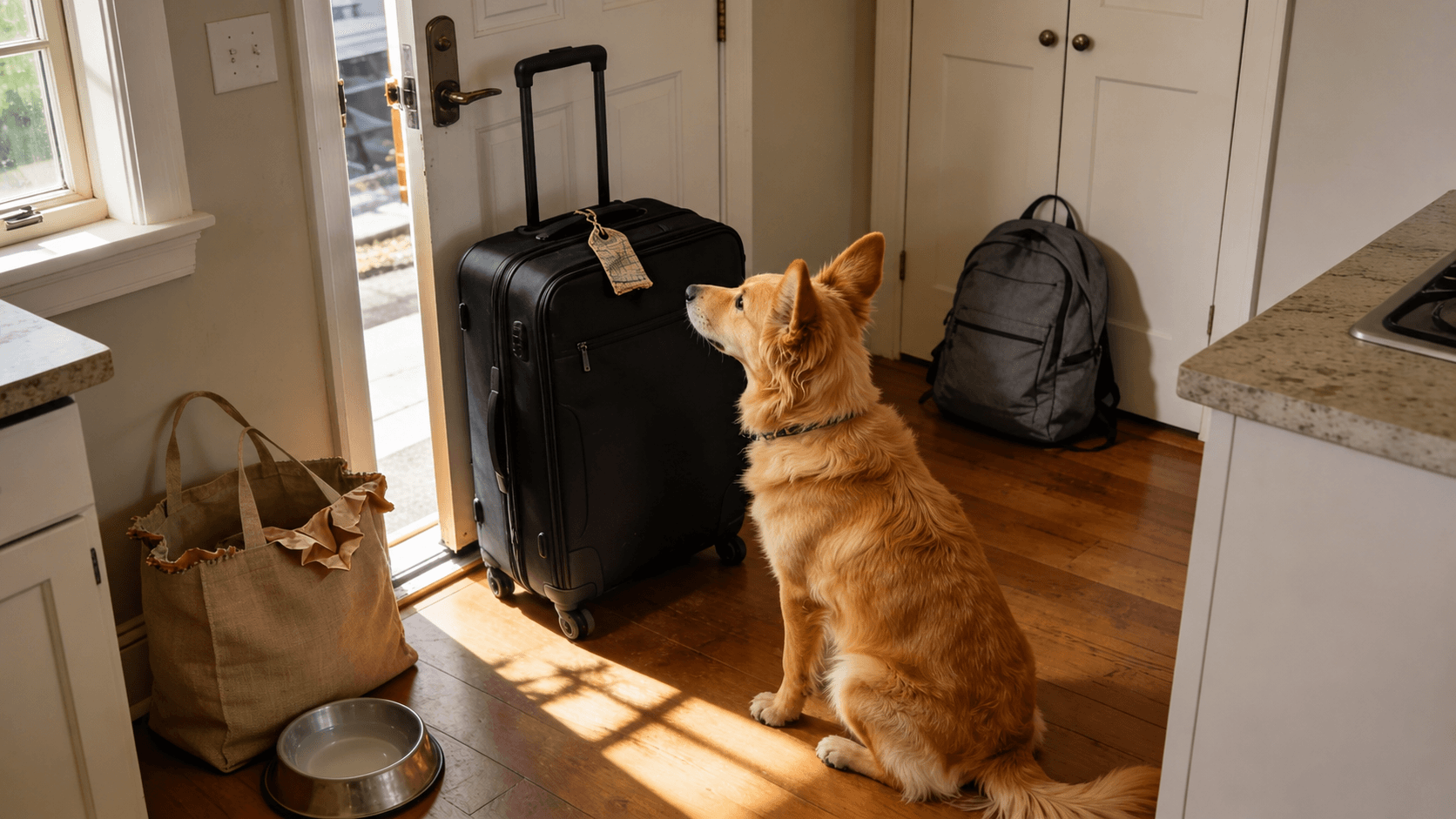
The reaction often starts before the zipper moves. A dog that was half-asleep suddenly shadows your every step when the suitcase comes out. A cat who ignored you all afternoon appears in the hallway the moment a backpack lands on the chair. Put a grocery bag on the counter and a pet that seemed uninterested in household chores may investigate as if a dinner bell just rang.
That uncanny timing can feel like mind reading, but it is usually something more interesting: pets are excellent students of routine. They do not need to understand the concept of travel, work, or errands in human terms. They only need to notice that certain objects tend to arrive just before particular outcomes.
Bags are not just objects; they are predictions
For a pet, a suitcase is rarely just luggage. It is part of a sequence. Over time, the sequence becomes familiar: suitcase appears, closet opens, clothes pile up, humans move differently, door shuts, person disappears for longer than usual. Once that pattern repeats a few times, the first cue in the chain can trigger a response all by itself.
This is everyday associative learning. The same process explains why some dogs sprint to the entryway at the sound of a leash clip, or why a cat materializes when it hears a can tab snap open. The bag becomes meaningful because it has a track record.
Different bags can carry very different forecasts:
Suitcase: longer absences, disrupted routines, unfamiliar energy in the home
Backpack or work tote: a shorter departure, often tied to a specific person leaving
Gym bag: a brief exit with a predictable return
Reusable grocery bag: possible food smells, kitchen activity, and dropped treats
Treat pouch or harness bag: a walk, car ride, or outdoor adventure
Pets do not need perfect accuracy to build these associations. They only need consistency often enough that the object becomes a useful clue.
Why the earliest cue gets the strongest reaction
What surprises owners is not that pets react, but how early they react. The dog is upset before anyone says goodbye. The cat vanishes before the front door opens. That early response makes sense when you consider how animals use information.
Visual cues matter because they arrive before the event itself. A pet that has learned the pattern does not wait for confirmation. It anticipates.
In practice, the bag is usually only one part of a larger ritual. Pets may be reading several signals at once:
The unusual time of day a bag appears
A change in your pace or tone of voice
Opening a closet or cabinet that is not accessed daily
Folding clothes, charging devices, or moving items near the door
The particular route you take through the house when preparing to leave
Dogs, especially, are adept at tracking human routines down to tiny deviations. Cats can be equally observant, though their response may be subtler. What looks like aloofness can actually be precise surveillance. A cat that relocates to a windowsill or hides under the bed may be responding just as clearly as a dog that whines and circles your legs.
This is one reason a “new bag” can be so potent. Novelty attracts attention, but the context around it supplies the meaning. If a bag only appears during trips, pets quickly learn that its arrival is not random.
What excitement, clinginess, and hiding are really saying
Not every pet reads the same bag the same way. One dog sees a backpack and assumes adventure. Another sees the same item and braces for being left behind. The emotional reaction depends on what history has attached to that object.
Excitement
If a bag predicts something rewarding, many pets become energized immediately. A day-hike pack, a beach tote, or the pouch where the leash lives can create a fast jump in arousal. Dogs may spin, bark, paw at the door, or bring a toy. Cats may head to the doorway, vocalize, or watch closely from a strategic position.
This response is often strongest when the object has been paired with an especially distinct routine. A dog that only sees a certain duffel bag before trips to the park may learn that the bag is better evidence than your words.
Hovering and clinginess
When a bag predicts separation, some pets switch into monitoring mode. They follow from room to room, lean against your legs, block the path to the door, or plant themselves on the clothing being packed. This is not always distress in a clinical sense. Often it is watchfulness: the pet is keeping track of a sequence it knows matters.
For social animals, proximity is also a reasonable response to uncertainty. If the pattern suggests someone will disappear for a while, staying close before the departure may be the pet’s version of gathering information or maximizing contact.
Hiding or quiet vigilance
Cats are famous for disappearing when carriers appear, but a suitcase or overnight bag can trigger similar behavior. Some dogs also retreat to another room when they sense disruptive activity. Hiding can be a stress response, but it can also be strategic avoidance based on experience. If a cat has learned that bag-related commotion is noisy or intrusive, leaving early is efficient.
The key point is that the reaction reflects expectation, not mystical foresight. Pets are reading the setup.
What this says about pet intelligence
The charming part of these bag reactions is that they reveal a sophisticated kind of intelligence that often goes unnoticed because it is built from ordinary life.
Pets are constantly sorting the home into patterns: sounds that matter, objects that predict change, people who follow certain routines, and events that tend to come next. That is a meaningful cognitive skill. It involves attention, memory, categorization, and the ability to generalize from repeated experience.
Animal behavior research has long shown that companion animals are sensitive to human cues, from gesture and posture to timing and repetition. Dogs have been especially studied for their responsiveness to human behavior, but cats are increasingly recognized as careful observers of household patterns too. A 2023 study published in *Current Biology* found that cats can match their owner’s voice to a corresponding face image, suggesting a richer mental representation of familiar humans than the stereotype of feline indifference would imply. That does not prove cats are decoding suitcases specifically, but it fits the broader picture: pets are paying attention.
What feels uncanny is often just the result of that attention being better than ours. Humans tune out routine. Pets, whose days are structured by those routines, often do not.
How to use the insight without confusing your pet more
Once you realize your pet has assigned meanings to bags and preparation rituals, you can make those cues work more cleanly.
For departures, consistency helps. If a suitcase reliably means a long absence, dramatic last-minute affection or chaotic packing may amplify tension. Calmer exits, practice with short departures, and avoiding drawn-out goodbyes can reduce the intensity around the object.
For positive outings, clarity matters. If one specific bag means “you are coming with me,” keep that association distinct. A dedicated walk pouch, car-ride tote, or travel blanket can become a useful signal that reduces ambiguity.
A few practical habits can help:
Separate departure cues from play cues so your pet is not constantly guessing
Pack earlier when possible to blunt the immediate spike in emotion
Use repeatable signals for outings such as the same harness station or treat bag
Reward calm behavior around loaded objects instead of only responding when excitement peaks
Notice individual preferences because one pet may love obvious cues while another does better with lower drama
The larger lesson is simple. Pets do not need language to understand the rhythm of a household. They build a map from objects, sequences, and outcomes. A new bag in view is rarely just clutter to them. It is evidence.
And once an animal has learned what that evidence tends to mean, the reaction can look uncannily precise. Not because your pet sees the future, but because it has become very good at reading what usually comes next.
Safety & Scope
This article is for general informational purposes and does not replace professional advice for complex repairs or installations.
Frequently Asked Questions
+Why does my dog react the moment I touch a suitcase?
Your dog has likely linked the suitcase to a repeated sequence: packing, a change in household activity, and you leaving for longer than usual. After enough repetition, the suitcase itself becomes an early warning cue, so the reaction starts before you even head for the door.
+How do cats know when someone is about to leave?
Cats often notice the preparation ritual rather than the departure itself. A bag appearing, a closet opening, shoes changing, keys moving, and a shift in your movement pattern can all signal that someone is about to go. Cats may respond by watching closely, staying nearby, or hiding.
+Can pets recognize specific bags or objects by routine?
Yes. Many pets learn that certain objects predict specific outcomes. A particular backpack may mean work, a grocery tote may mean food activity, and a harness bag may mean a walk. The stronger and more consistent the routine, the more likely a pet is to recognize the object as a reliable cue.