The Living Room Patrol: What Small Pets Check Before They Relax
Rabbits, guinea pigs, and other small companions rarely flop down the moment they enter a room. Before they settle, many run a quick but detailed safety scan of sound, movement, sightlines, footing, and escape options.
Maya covers pets & animal lifestyle with an emphasis on practical analysis, products, and real-world impact.
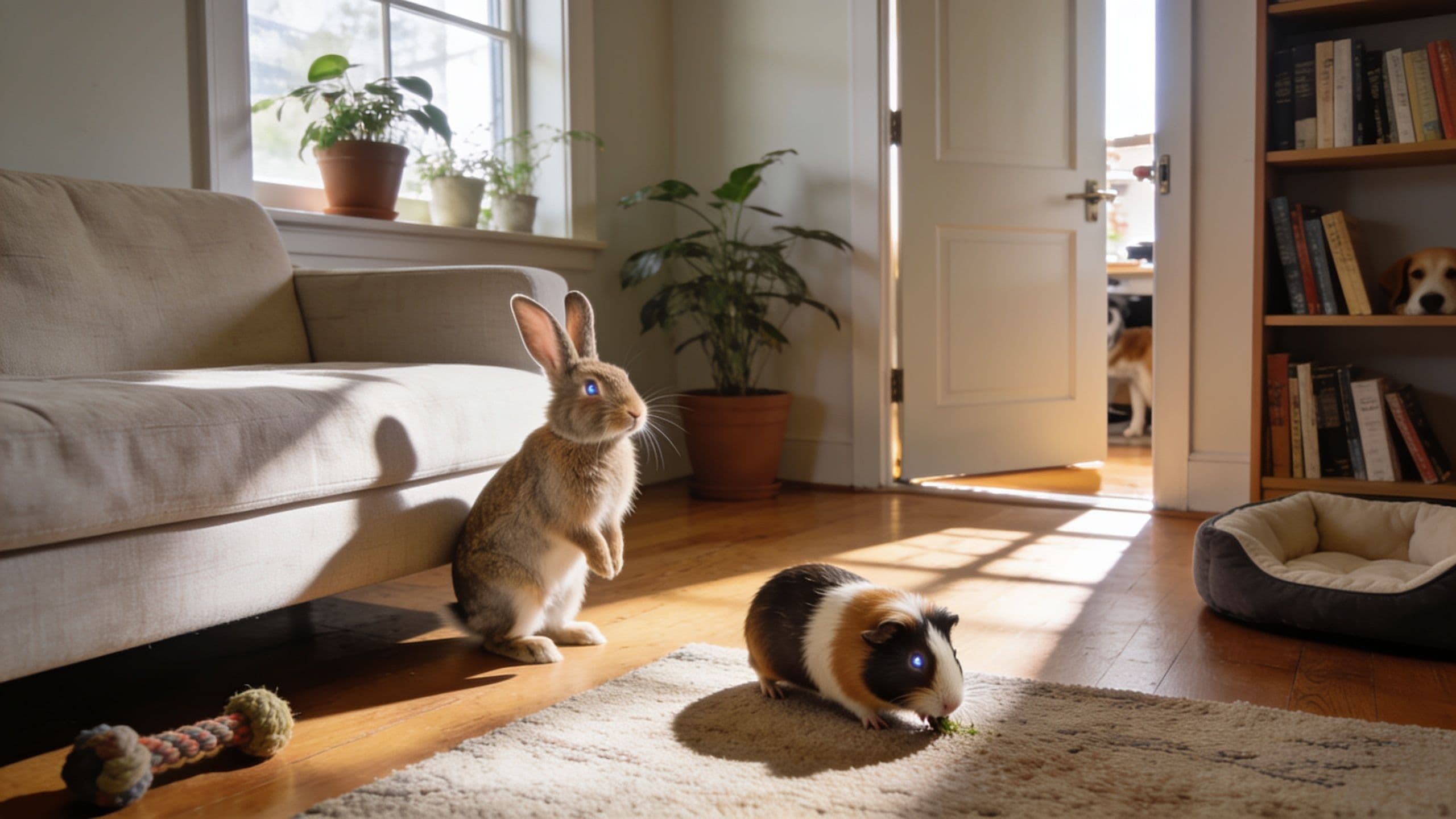
A rabbit lingering at the edge of the rug or a guinea pig freezing beside a hide is not being dramatic. That pause is often a decision-making moment. Small pets live close to the ground, process a lot of information quickly, and tend to relax only after a room has passed a series of quiet checks.
Owners often read this as shyness or stubbornness. More often, it is environmental assessment. Rabbits, guinea pigs, chinchillas, and other small companions are remarkably sensitive home-readers: they notice whether the floor feels different, whether a chair has moved, whether footsteps are approaching, and whether there is cover within sprinting distance.
That is why “settling in” can look delayed. Relaxation usually comes after surveillance.
They start with the room’s risk map
Before a small pet stretches out, loafs, or starts grooming in the open, it often maps the basics of safety.
Open sightlines matter. A rabbit entering the living room may stop, lift its head, and visually sweep the area before moving farther from the wall. Guinea pigs often do something similar from the mouth of a tunnel or fleece forest, deciding whether the exposed part of the room is worth crossing. Wide open floor space can be attractive for zoomies, but only if there is a believable retreat route.
Hide access is usually part of the calculation. Many small pets seem noticeably more confident when they can identify at least one nearby shelter: a cardboard castle, a fabric tunnel, a low table skirted with a blanket, or a pen corner that functions as a safe base. It is not only the presence of a hide that matters, but the distance to it. If they cannot reach cover quickly, they may stay watchful longer.
Furniture layout also creates a mental map. To humans, shifting an ottoman a few feet or rotating a coffee table may feel minor. To a rabbit or guinea pig, it changes traffic lanes, blind corners, and escape geometry. A familiar route along the sofa edge may suddenly feel exposed. That is why pets sometimes hesitate after cleaning day or room rearranging, even when nothing “important” seems different.
Sound and vibration often matter more than owners realize
Small pets do not experience a living room as a mainly visual space. They read it through layers of sound and floor feedback.
A television at moderate volume may be perfectly tolerable one evening and unsettling the next if it is paired with sharper laughter, clattering dishes from the kitchen, or someone pacing in shoes with harder footfalls. Rabbits in particular often react not just to noise level but to noise pattern. Repeating, predictable sounds are easier to absorb than irregular bursts. A washing machine rumble in the next room may fade into the background; a dropped remote can reset the whole patrol.
Guinea pigs can be especially responsive to household rhythm. They often settle faster when the room’s activity is consistent and legible: the same people in the same seats, the same pathways, the same rough timing. Sudden movement across their field of view, especially from above, tends to keep them alert longer.
Then there is vibration. For a pet standing on hardwood, laminate, or a thin rug, approaching footsteps can register through the floor before a person is fully visible. That can produce a brief freeze, a change in ear position, or a quick retreat to cover. Owners who switch to a thicker play mat or provide more traction often see confidence improve, not because the pet has become “braver,” but because the room has become easier to interpret.
Why caution can look like curiosity
The same behaviors that signal environmental checking are often mistaken for random indecision.
A rabbit pausing upright is gathering information. That taller posture expands visibility and often appears just before movement into a more exposed area. Brief freezing can serve a similar purpose: stop, listen, reassess, continue or retreat. Running halfway to a destination, turning back, then trying again may not mean the pet forgot where it was going. It can be route testing.
Guinea pigs show their own version of this pattern. A pig may poke its head from a hide, withdraw, then emerge farther the next time. It may cross to a food pile but keep one end of the body angled toward shelter. It may begin nibbling, stop to scan, then resume once the room remains stable.
This is one reason confidence should not be judged only by speed. A pet that charges around immediately is not always more comfortable than one that inspects first. For many prey-oriented species, caution is part of normal competence. They are not failing to relax; they are establishing the conditions that make relaxation possible.
The details that help a room feel readable
Owners can do a surprising amount to make the living room easier for small pets to decode.
Cover beats openness alone
Many people create an exercise space with plenty of floor area but too little intermediate cover. A better setup usually includes visible safe points every few feet: tunnels, stools, fleece drapes, cardboard arches, or low platforms. The goal is not to clutter the room, but to break exposure into manageable segments.
For rabbits, a room often feels more usable when there are edges to travel along rather than one giant open center. For guinea pigs, layered cover can be the difference between constant dashing and calm grazing.
Consistency builds speed
When possible, keep key items in stable positions. Favorite hides, water bowls, hay stations, and trusted pathways become landmarks. If the room has to change, expect a brief return to patrol behavior. That hesitation is useful feedback: the pet is noticing the shift, not overreacting.
Traction changes confidence
Slippery flooring can make even a familiar room feel risky. Rabbits who dislike laminate often move with obvious caution until rugs, yoga mats, or foam tiles create secure launch and landing points. Guinea pigs may also traverse more confidently when footing is predictable and routes are not interrupted by slick patches.
Traffic patterns matter
A room can be quiet but still feel busy if people frequently cut across the pet’s routes. Repeated overhead reach-ins, children changing direction unpredictably, or a dog passing the pen every few minutes can all keep small pets in low-level assessment mode. Calm does not mean silence; it means the environment is understandable.
The everyday moments owners tend to recognize once they know the pattern
Post-cleaning hesitation is one of the clearest examples. Fresh smells, moved objects, vacuum noise, and altered floor textures can make a familiar living room feel newly uncertain. A rabbit that normally flops within minutes may spend longer circling the perimeter. A guinea pig may remain under cover until room activity stabilizes.
Night behavior can differ too. Many small pets become bolder in lower light and reduced household traffic. The same rabbit that tiptoes around a bustling afternoon living room may sprawl confidently after 10 p.m. when footsteps stop and sightlines feel calmer. Owners often interpret this as a personality shift, when it may simply reflect a more readable environment.
Familiar corners are another giveaway. Pets tend to settle faster in areas that preserve both memory and control: the rug edge beside the sofa, the tunnel near the bookcase, the corner with two retreat options instead of one. These are not arbitrary preferences. They are places that have repeatedly passed inspection.
Even social trust fits into the patrol. A rabbit may relax beside a person who stays seated and predictable, while remaining guarded around someone who leans over suddenly or walks past at irregular intervals. Guinea pigs often accept company best when that company does not keep rewriting the room with movement.
The practical takeaway is simple: if a small pet pauses before relaxing, watch the room before you judge the animal. What changed in sound, floor feel, cover, layout, or traffic? Their behavior often makes sense once the environment is read at ground level.
What looks like a delay is usually intelligence at work. The living room patrol is not a quirk to correct. It is how small pets turn shared human space into somewhere safe enough to rest.
Safety & Scope
This article is for general informational purposes and does not replace professional advice for complex repairs or installations.
Frequently Asked Questions
+Why does my rabbit pause and look around before moving?
Your rabbit is often checking sightlines, sounds, floor stability, and access to cover before crossing open space. That pause is a normal safety assessment, especially if the room is noisy, recently changed, or has slippery flooring.
+How do guinea pigs decide a room feels safe?
Guinea pigs usually look for nearby shelter, predictable noise, stable movement around them, and easy retreat routes. They tend to settle faster when the layout is familiar and the room includes multiple hides or covered paths.
+Do small pets notice furniture changes and noise patterns?
Yes. Small pets often notice moved furniture, altered pathways, fresh cleaning smells, new floor textures, and irregular noise. Even small layout changes can affect how quickly they relax because those changes alter their sense of safety and escape options.