The Human Habits Pets Learn Faster Than We Notice
Pets often map our daily patterns with startling precision, from the shoes that mean a walk to the laptop snap that signals dinner. The most revealing part of life with animals is not just what we teach them, but what they quietly learn from us.
Jordan specializes in turning complex pets & animal lifestyle topics into clear, useful explainers for everyday readers.
Pets are often experts in us long before we realize it. Many owners think of training as a one-way process: humans give cues, animals learn commands, routine follows. In daily life, though, pets are just as busy training their attention on us. They study sequences, moods, objects, sounds, and timing with a consistency most people only notice after the fact.
That is why a dog can start spinning before the leash appears, or a cat can materialize the second a laptop closes. What looks like intuition is usually pattern recognition. Pets do not need a formal lesson to learn that one pair of shoes means the park, one coat means you are leaving without them, and a certain tone of voice means the household energy is about to change.
The routines pets read before we do
The fastest habits pets learn are rarely dramatic. They are the tiny repeated actions that happen in the same order every day.
Morning routines are a common example. An alarm goes off, feet hit the floor, bathroom light turns on, coffee starts, blinds open, food bowls clink. To a pet, these are not isolated events. They are linked signals in a chain. If breakfast usually follows the sound of a cabinet door or the movement toward a certain shelf, that sound or motion can become more meaningful than the food itself.
Workday cues are another rich source of information. Dogs and cats often learn the difference between "still busy" and "available now" from remarkably subtle markers: a laptop lid closing, headphones coming off, a desk chair rolling back, a phone call ending, or the exact moment a person stands up and stretches. Owners may think they have not said or done anything clear, but the pet has already logged the pattern dozens of times.
Pre-walk rituals are especially easy for animals to decode because they are emotionally loaded and highly repetitive. Reaching for a treat pouch, changing into certain clothes, patting your pockets for keys, or walking toward the hook where the leash hangs can all become stronger signals than the word "walk."
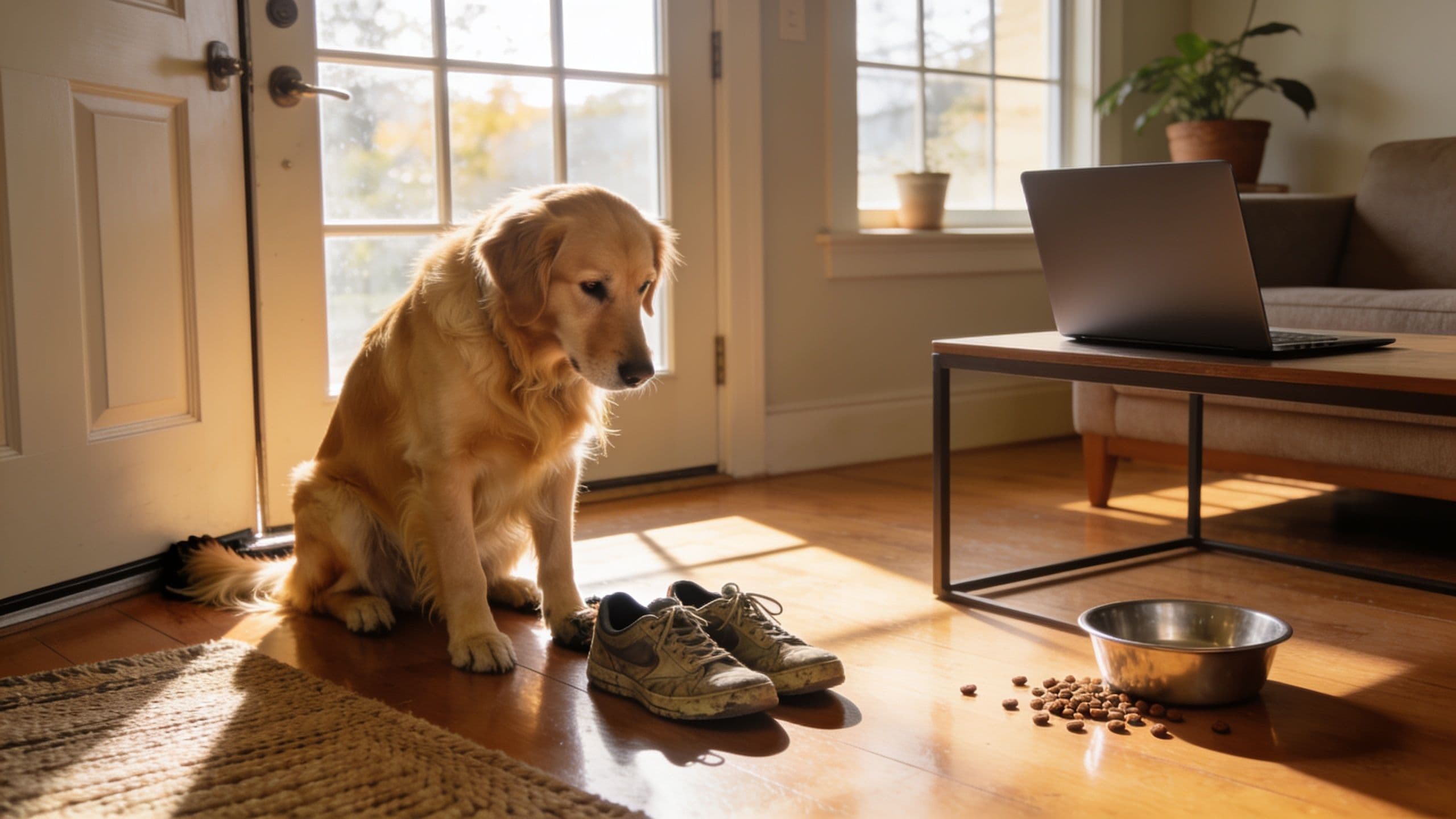
Then there are exit routines. Many dogs, in particular, can distinguish between "we are leaving together" and "you are leaving me here" based on clothing, pace, and object choices. Picking up a gym bag may mean one thing. Picking up a laptop bag may mean another. The difference between putting on sneakers and putting on office shoes can matter more than owners expect.
Tiny cues become big predictions
Pets learn quickly because home life gives them ideal conditions for associative learning: repetition, reliable outcomes, and a close-up view of human behavior.
Repetition does most of the work. If a certain event regularly predicts another event, pets start treating the first one as meaningful. This is why a cat may run to the kitchen at the sound of a can opener even if the sound is not always for them. It is also why a dog may react to the rustle of a specific jacket that often precedes a trip outside.
Predictable consequences strengthen the lesson. If your standing up from the desk often leads to play, attention, dinner, or a walk, that movement gains importance. If closing the laptop usually means your availability suddenly changes, a pet can learn to respond before you even push the chair back.
Pets are also deeply attentive to environmental changes people barely register. They notice shifts in pace, posture, direction, and energy. A person moving casually through the house is different from a person moving with purpose. A hand reaching toward the closet differs from a hand reaching toward the sink. To us, these distinctions feel minor. To a pet watching the same space all day, they can be highly informative.
This sensitivity helps explain why animals seem to know our schedule better than we do. They are not distracted by calendars, notifications, or multitasking. They watch the same patterns unfold from a low, observant vantage point and connect what reliably comes next.
Pets also learn our moods, not just our schedules
The most impressive reading pets do is often emotional rather than logistical. Tone of voice, breathing, facial tension, walking speed, and body position can all signal changes in household atmosphere.
Dogs are especially known for tracking human social cues, but cats do it too, often in ways owners underestimate. A pet may approach more carefully when your movements are abrupt, linger nearby when you sound upset, or disappear when they sense overstimulation in the room. That response is not necessarily a judgment about the emotion itself. It is often a learned prediction about what tends to happen next.
If raised voices in a home usually lead to less attention, busier movement, or doors opening and closing, a pet may become alert at the earliest sign of that pattern. If a soft voice and slow movement often mean cuddle time on the sofa, those cues gain their own emotional meaning.
This is one reason accidental cueing happens so easily. Owners may believe they are hiding intention, but pets often react to tension before a decision is visible. A dog who dislikes being left alone may start pacing not when you open the front door, but when your movement pattern shifts into "departure mode." A cat who wants evening attention may start circling before you actually settle down, because the sequence has already begun.
The accidental signals owners teach every day
Some of the strongest pet behaviors are built on signals humans never meant to create.
Specific phrases are a classic case. Owners often repeat words like "later," "outside," or "treat" in normal conversation, then wonder why the dog reacts every time. Pets do not need perfect language comprehension to pick up recurring sound patterns attached to meaningful outcomes.
Clothing is another powerful cue. One jacket may predict a quick errand. Another may predict a long walk. Even items like workout leggings, a winter coat, or headphones can develop associations if they consistently precede a certain kind of activity.
Technology has created new household cues too. The laptop close is a modern classic because it often marks a real shift in attention. The sound of a video meeting ending, the click of a game console turning off, or the chime of an evening alarm can all become embedded in a pet's daily map of events.
These signals can be helpful when they create smooth transitions. They can be disruptive when they trigger frantic anticipation. A dog who explodes with excitement every time you stand up from your desk is responding logically to a pattern that has been reinforced. The issue is not stubbornness. The issue is that the cue has become too predictive and too emotionally charged.
Using your pet's people-reading to create calmer days
Once owners recognize how much pets learn from observation, home behavior becomes easier to shape.
The first step is to notice your own repeatable sequences. If your dog gets overstimulated before every walk, the excitement may be starting several steps before the leash appears. Slowing the routine, pausing between steps, or varying the order can reduce the buildup.
The second step is to make intentional cues clearer than accidental ones. If you want a pet to understand when interaction is coming, choose a specific signal and use it consistently. That might be a phrase, a mat cue, or picking up one dedicated object before play. Clear communication can lower the need for pets to guess from every micro-movement.
It also helps to remove or soften signals that trigger unnecessary stress. If your dog starts worrying the moment work shoes go on, you can occasionally put them on without leaving, or pair departure-related actions with calm, neutral moments. The goal is not to confuse the pet, but to make every pre-departure cue less loaded.
For cats, predictable transition rituals can be especially effective. If closing the laptop leads to frantic meowing because it has become the nightly dinner marker, adding a brief buffer activity can help. Walk to another room, reset the sequence, or build a calmer feeding cue that does not depend entirely on your work ending.
What matters most is understanding that pets respond to patterns more than intentions. We may mean to communicate one thing, while our body language, timing, and routines communicate something else entirely.
Living well with animals often comes down to this quiet two-way observation. We teach them commands, boundaries, and schedules. They learn our routes through the house, the sounds of our moods, the objects that predict our absence, and the tiny gestures that mean their favorite part of the day is close. Recognizing that process does not make pets mysterious. It makes them easier to understand, and often easier to help.
Safety & Scope
This article is for general informational purposes and does not replace professional advice for complex repairs or installations.
Frequently Asked Questions
+How do pets learn our routines so quickly?
They learn through repetition and association. When the same small actions reliably lead to the same outcome, pets begin treating those actions as signals. Over time, sounds, objects, movement patterns, and timing become strong predictors of what happens next.
+Can my dog tell when I am about to leave the house?
Usually yes, especially if your departure routine is consistent. Dogs often notice cues such as changing shoes, picking up keys, putting on a certain jacket, or moving through the house with a different pace and purpose.
+Why does my cat react when I close my laptop?
Your cat may have learned that closing the laptop predicts a change in attention, feeding, play, or movement around the home. The laptop itself is not magical; it has simply become a reliable marker in your cat's daily routine.