The Case for Two Rest Zones in a Multi-Pet Home
A single pet bed in the busiest room often creates subtle competition rather than comfort. In multi-pet homes, two distinct rest zones—a social spot near people and a quieter retreat away from traffic—can lower tension and help each animal settle more easily.
Maya covers pets & animal lifestyle with an emphasis on practical analysis, products, and real-world impact.
One plush bed in the living room can look generous, but in a home with multiple animals, it often becomes prime real estate. The problem is not only scarcity. It is that pets use rest differently. One wants to be near the sofa. Another wants distance from footsteps. A third wants the warm patch by the window at 3 p.m. When every animal is expected to settle in one shared area, minor preferences can turn into constant low-level friction.
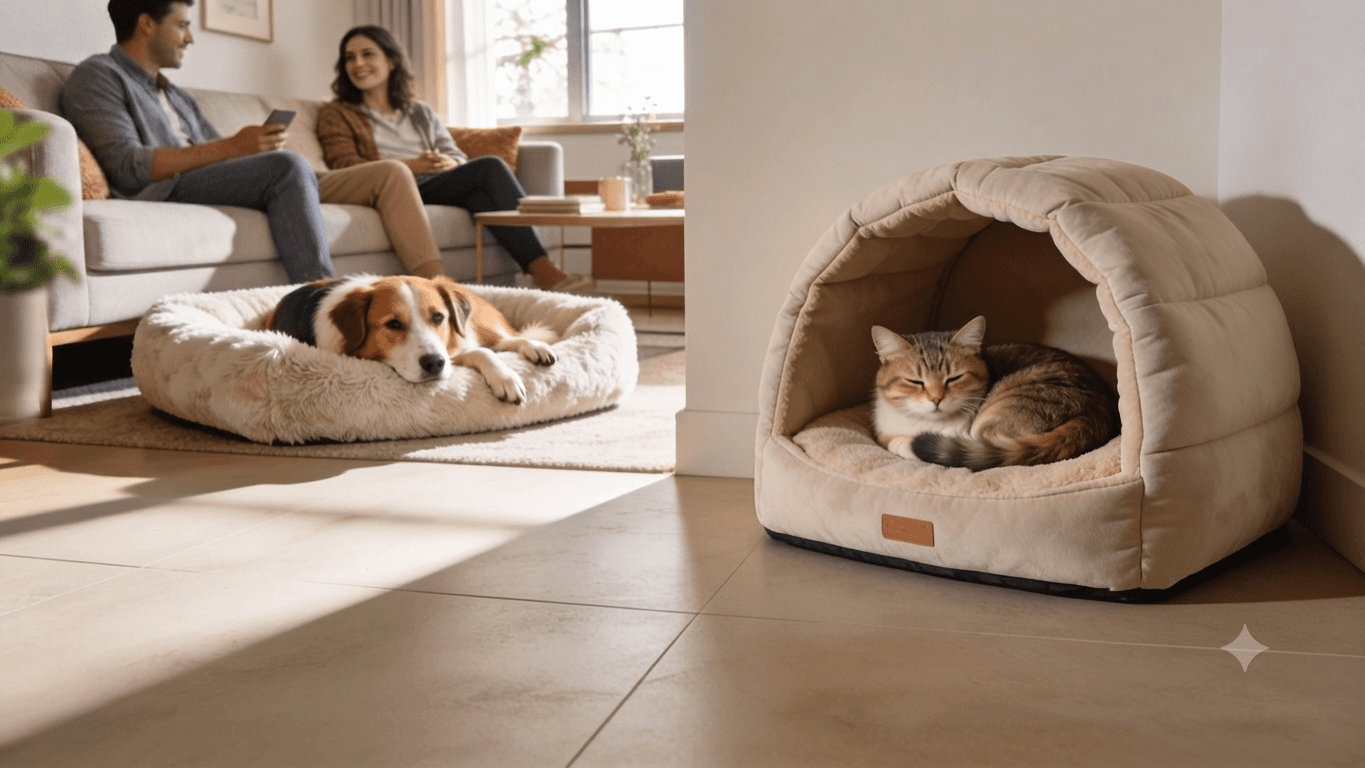
That is why the most useful layout rule for a multi-pet home is simple: build at least two dependable rest zones. Not just two beds dropped at random, but two distinct types of space. One should be social, close to people and everyday activity. The other should be quieter, protected from traffic and interruption. Together, those zones give pets a choice that many homes accidentally remove.
Why one shared resting area often creates tension
When owners notice conflict, they usually look for obvious incidents: growling, swatting, chasing, or one pet refusing to enter a room. But competition around rest often shows up in softer ways first.
A single preferred spot concentrates several things animals care about at once:
proximity to humans
access to warmth or airflow
visibility of doors, windows, and movement
a sense of safety from surprise approach
ownership through repeated use and scent
If two or three pets all value that same spot for different reasons, the result may be constant displacement. One dog stands over the bed until the other leaves. A cat jumps down whenever the hallway gets noisy, then returns to reclaim the cushion. A bonded pair of pets seems unsettled because one always arrives second and settles poorly.
This does not always look dramatic. Sometimes it looks like a pet circling, hovering, or lying down briefly only to move again five minutes later. Sometimes it looks like an animal choosing the floor, a doorway, or under a table instead of the expensive bed that was bought for comfort. The issue is often not the bed itself. It is the lack of meaningful alternatives.
The two-zone principle: social comfort and protected quiet
The strongest multi-pet setups tend to separate resting opportunities by function.
Zone one: the social rest area
This is the place for pets that want to stay near the household. It belongs close to daily human presence: the living room, home office, or a family room where people spend real time. For many dogs, this is the preferred zone because they often rest best when they can monitor the room and remain loosely connected to their people.
A social rest area works best when it offers more than one exact position. That may mean a dog bed near the sofa plus a cat perch by the window, or two mats placed with enough distance that one pet is not forced to pass directly through the other’s space.
The goal is not to create a crowd around one attractive object. It is to create a shared room with several viable resting choices.
Zone two: the quiet retreat
This is the space many homes forget. It should sit away from traffic, vacuum noise, children’s play paths, and frequent door movement. A bedroom corner, low-traffic study, spare room, or sheltered landing can work well.
Cats often use this kind of zone especially well, particularly if it includes height, partial enclosure, or a narrow approach that prevents ambush. Many dogs also benefit from a true retreat, especially older dogs, nervous rescues, and animals that have to work harder to tolerate household motion. Small pets, including rabbits and other companion animals sensitive to disturbance, generally do better when their rest area is not embedded in the busiest social space.
The key is reliability. A retreat only works if other pets, children, and household activity do not constantly invade it.
Different species, different rest logic
A two-zone setup works because dogs, cats, and small pets often solve the same problem in different ways.
Dogs often choose room-level closeness
Many dogs prioritize social contact over seclusion. They may nap more deeply when they can see their people, hear the kitchen, or track movement between rooms. That does not mean they want interruption. It means they often prefer to rest within the social field of the home.
This is one reason dogs may repeatedly abandon a bed placed in an isolated room. The bed is comfortable, but the location is socially wrong.
Cats often value control more than proximity
Cats can be highly social, but rest is often tied to control: control of approach, height, temperature, and escape routes. A cat may ignore a lovely shared pet bed if it is too exposed or too easy for a dog to investigate.
For cats, a second zone is often most successful when it adds vertical space or partial concealment. A window hammock, a shelf with a pad, a covered bed in a quiet room, or the top tier of a sturdy cat tree can convert unused square footage into real relief.
Small pets usually need lower-disturbance placement
Rabbits, guinea pigs, and similar companion animals can be stressed by constant pass-through activity and the looming presence of larger pets, even in homes where everyone coexists peacefully. Their rest and hide areas generally work better in steady, predictable corners rather than in the center of a family room.
In mixed-species homes, this distinction matters. Equal affection does not mean identical spatial needs.
The signs your home needs more than one reliable rest area
Most owners do not need a behavior consult to spot the pattern. A few repeated household moments usually tell the story.
Watch for these signs:
one pet regularly takes over the other’s bed despite multiple soft surfaces elsewhere
a pet waits nearby until a favored spot opens up
frequent sighing, circling, and resettling in the evening
one animal leaves when another enters, even without overt conflict
pets choose transitional spaces like hallways, stairs, or doorways to rest
a cat spends most downtime on top of furniture rather than using floor-level beds
an older or shy pet seems calmer only when alone in a separate room
These are not always signs of serious incompatibility. More often, they mean the home offers comfort but not enough choice.
Setup upgrades that make the two-zone idea work
The good news is that this principle rarely requires a renovation. It usually works through placement, variety, and a little protection.
Vary texture, temperature, and height
Not every pet wants the same surface. One may prefer a bolstered bed, another a cool flat mat, another a fleece-lined cave. If every resting option feels identical, you are not really offering multiple choices.
Try to diversify:
one warm, cushioned bed
one cooler, flatter surface
one elevated option for cats
one tucked-away option with partial cover
A sunny spot and a shaded spot can matter as much as the bed style itself.
Spread resources across rooms, not just corners
Owners often cluster all pet furniture in one area, then wonder why tension remains. If the social bed, crate, cat tree, and blanket are all within a few feet of each other, the household still has one functional zone.
A better approach is geographic separation. Put one appealing rest setup where the family gathers and another in a room or corner that stays consistently calm. Distance reduces visual pressure and gives lower-confidence pets a real alternative.
Protect the quiet zone from interruption
A retreat is not a retreat if another pet can barge in every few minutes. Use baby gates, furniture arrangement, vertical access, or simple household rules to keep the area predictable. For cats, that might mean a perch the dog cannot reach. For dogs, it may mean a bed placed behind a chair or in a bedroom with limited traffic.
This matters most in the evening, when pets are tired and less tolerant of being displaced.
Keep favored human access available in more than one place
Sometimes the “best” bed is really the bed closest to the person. If one pet always wins that location, the other may be choosing between comfort and companionship.
A second social option can help: a mat near the desk, a bed on the far side of the sofa, or a bench-level perch near the same room activity. Shared peace often improves when no single spot controls access to the household’s center of gravity.
More choice usually means less policing
The biggest advantage of two rest zones is that pets begin solving small conflicts on their own. Instead of waiting for owners to intervene, they can choose distance, privacy, or social contact depending on the moment. That flexibility lowers the number of tiny negotiations happening all day.
In practical terms, it often means fewer stare-downs, fewer silent takeovers, and fewer cases where one pet is technically included but never fully relaxed. The calmest multi-pet homes are not always the ones with the most floor space or the most expensive accessories. They are the ones that make settling easy.
If your animals are comfortable but not quite at ease, the fix may be less about buying another bed and more about giving rest two clear destinations: one near the life of the home, and one safely outside its flow.
Safety & Scope
This article is for general informational purposes and does not replace professional advice for complex repairs or installations.
Frequently Asked Questions
+How many resting spots should pets have in one home?
In a multi-pet home, aim for more resting options than the number of pets, with at least two distinct zones: one social area near people and one quieter retreat away from traffic. Extra variety in height, texture, and room placement helps reduce competition.
+Do cats and dogs need separate quiet spaces?
Often, yes. Dogs may prefer resting near household activity, while cats frequently value elevated or secluded areas with more control over approach. Separate quiet spaces let each species rest in ways that match its natural preferences.
+Why does one pet keep taking over the other’s bed?
The bed may offer something more valuable than softness, such as warmth, a better view, closer human access, or a stronger sense of safety. When one spot is clearly the best location, pets compete for it. Creating a second equally appealing rest zone usually reduces this pattern.