For Pets, the Hallway Is a Social Border Rather Than Just a Passage
To people, a hallway is dead space between rooms. To pets, it can be a lookout post, an acoustic channel, and a boundary where movement, territory, and social routines are easiest to read.
Maya covers pets & animal lifestyle with an emphasis on practical analysis, products, and real-world impact.
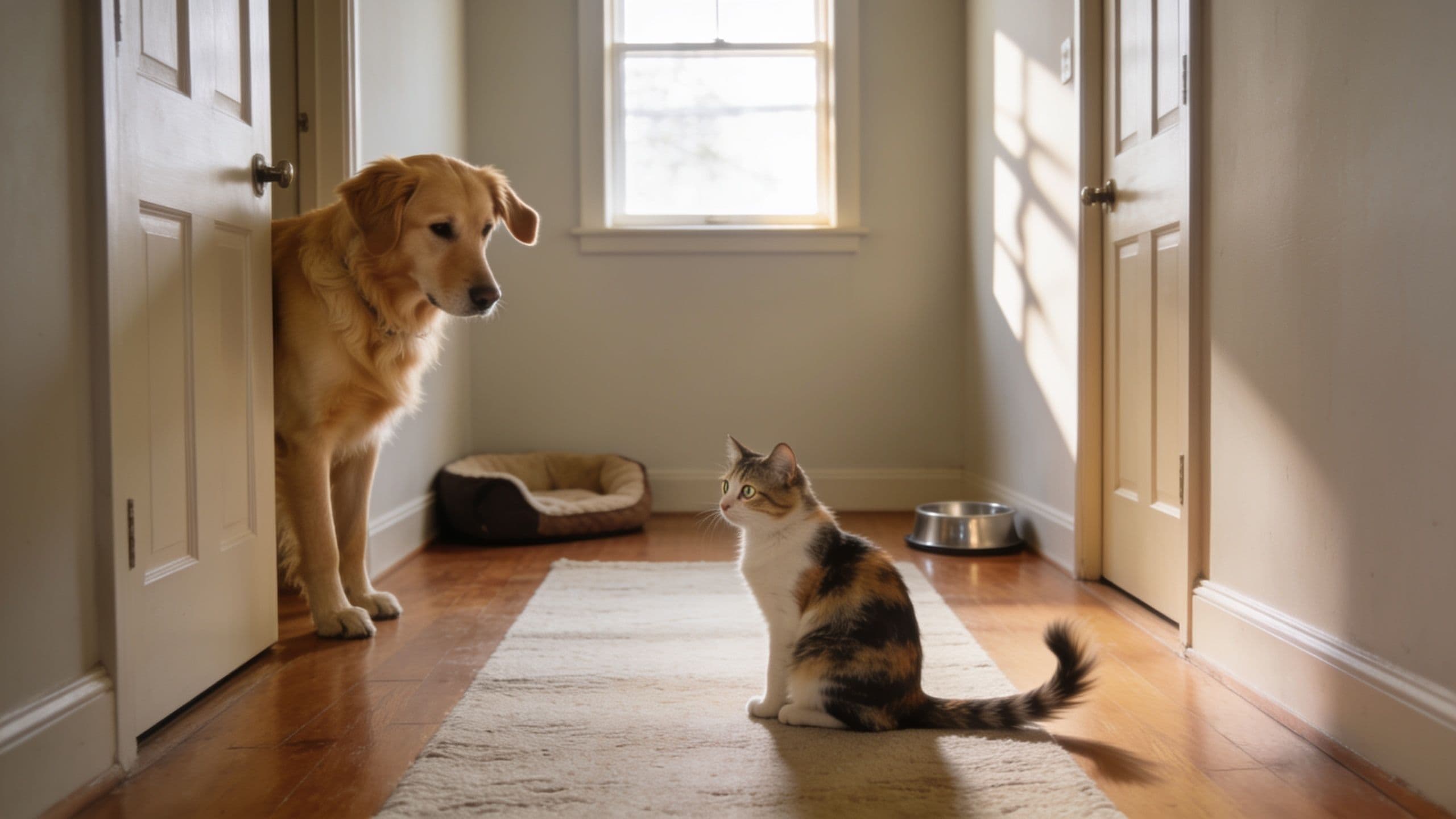
A pet stretched across the hallway floor is not necessarily being inconvenient by accident. In many homes, that narrow strip of space functions less like a corridor and more like a border crossing: a place where sounds arrive first, bodies pass through predictably, and social information is concentrated.
That helps explain a familiar set of behaviors. Dogs station themselves outside bedroom doors before anyone wakes up. Cats pause in the doorway, assess the room, then decide whether to enter. Rabbits and other small pets often prefer to observe from the edge of a threshold rather than move straight into the center of a busy room. What looks like hesitation, stubbornness, or random lounging is often strategic placement.
Why pets treat transition spaces as prime real estate
Rooms hold resources, but hallways reveal movement. For an animal that depends on anticipating who is coming, where noise is coming from, and whether a space feels safe, a transition zone offers an unusual amount of information.
Hallways also amplify sound. Footsteps, doors opening, voices from another room, the rattle of a food bowl from the kitchen: these cues travel clearly through narrow passageways. A dog lying in the hall may be doing what dogs do best—monitoring household activity without constantly chasing it. A cat parked near a doorway can hear and assess before committing to action.
Visibility matters too. From a hallway or threshold, a pet can often watch several directions at once. One position may provide sightlines into the living room, kitchen, front door, and stairs. That makes the space useful for social tracking. Pets learn routines quickly, and many prefer a location where they can observe changes in human movement with minimal effort.
There is also a control element. Doorways and halls are bottlenecks. If one person, another pet, or a delivery at the front door is likely to pass through a certain point, that point becomes behaviorally important. Animals use bottlenecks to greet, avoid, intercept, supervise, or simply stay informed.
The pause at the doorway is often a decision point
Cats are especially associated with stopping at thresholds, but dogs do it too. That pause is rarely meaningless. A doorway separates one sensory environment from another: different flooring, different smells, another pet’s resting spot, brighter light, a louder television, or a room associated with nail trims, baths, or visitors.
Crossing into a room means updating expectations. Is the space occupied? Is there an easy retreat path? Is another animal already there? Is the human inside active, asleep, or holding something interesting? Pausing gives the pet a moment to collect information before entering.
This can be even more pronounced in multi-pet homes. A doorway is a place where one animal can negotiate access without fully exposing itself. A cat may hover at the threshold of a room occupied by a dog, not because the cat is confused, but because thresholds allow cautious social testing. Entering can wait until the signals look favorable.
Floor texture can matter as much as social context. Many owners notice pets reluctant to cross from carpet to hardwood, or from a rug into a slick hallway. That is not only a comfort issue; it can change how confidently an animal uses the space. A transition zone may feel like a border partly because the surface itself announces a shift in footing and control.
Why so many pets choose to lie right in the middle
The classic hallway sprawl makes sense once the space is viewed as a command post. The middle of the hall can be cool, open, and acoustically rich. It may also be the one place in the home where a pet can detect traffic from nearly every major room.
For dogs, this often reads like low-level patrol behavior. Not guarding in an exaggerated sense, but keeping tabs on the social map of the household. A dog in the hall can notice who gets out of bed, who heads toward the kitchen, whether someone approaches the front door, and whether another dog is moving toward a favorite resting area.
For cats, the behavior may be less about blocking access and more about choosing a neutral vantage point. Instead of committing to one person’s lap or one room’s activity, a hallway gives the cat options. It can remain connected to the household while avoiding overstimulation.
Small pets, when allowed supervised access beyond their enclosure, often favor edges and partial cover near transitions rather than open centers. That reflects prey-animal logic: monitor activity from a place that offers fast retreat and good information.
Temperature and airflow can reinforce all of this. Hallways often collect breezes from vents, fan-driven air movement, or cooler flooring. A pet may choose the hall partly for comfort, but comfort and surveillance are not mutually exclusive. The best resting spot is frequently the one that feels good and keeps the household legible.
Dogs, cats, and small pets read the same space differently
Dogs: movement trackers and interceptors
Dogs are highly attuned to routine and approach paths. A hallway lets them predict events before those events fully arrive. That is why many dogs greet people not in the room they started from, but halfway there. They intercept movement. In practical terms, the hall is where the day becomes visible.
Some dogs also use doorways as social checkpoints. They may wait outside a bathroom, bedroom, or nursery not because they urgently need access, but because those boundaries are where separation and reunion happen most often.
Cats: thresholds as observation tools
Cats often prefer the edge over the center. A doorway offers partial concealment, a clean retreat route, and a way to inspect a room without surrendering control. That can make hall-to-room transitions feel especially meaningful.
In homes with tension between pets, thresholds may become negotiated spaces. One cat may claim a room interior while another controls the approach. Owners sometimes interpret this as random stalling when it is actually subtle social choreography.
Small pets: cautious expansion from safe zones
Rabbits, ferrets, and similarly curious small animals often use transitional spaces as testing grounds. They may emerge, stop, scan, and only then continue. Because they are balancing exploration with vulnerability, a border space is useful: close enough to activity to stay informed, close enough to safety to retreat.
What hallway behavior reveals about life inside the home
The most revealing part of hallway behavior is that it shows pets map homes through movement, not just rooms. Humans think in terms of destinations: bedroom, kitchen, office. Pets often think in terms of approach, access, sound, visibility, and escape.
That perspective explains why a pet may ignore a spacious room and instead choose the narrow passage outside it. The passage may offer better data. It may be where family members reliably appear, where another pet can be monitored without direct confrontation, or where the animal feels included without being crowded.
It can also reveal confidence levels. A relaxed pet may lie fully exposed in the center of a hall because the location feels socially secure. A more cautious animal may hover at the edge of a doorway, leaning on the informational benefits of the space while preserving distance. Changes in those patterns can be meaningful. A pet that suddenly avoids a familiar hallway may be reacting to a new noise source, a slippery runner removed from the floor, construction sounds, or tension with another animal.
Owners who pay attention to these pause points often learn more about household dynamics than they expect. Which door does the cat monitor? Where does the dog wait when guests arrive? Which threshold does a small pet approach but rarely cross? Those choices show where the home feels predictable, contested, inviting, or overstimulating.
The hallway, in other words, is not empty space in a pet’s mental map. It is where domestic life announces itself first. Watching how an animal uses that border can reveal how it reads the household: who matters, what patterns are stable, and where caution or confidence begins.
Safety & Scope
This article is for general informational purposes and does not replace professional advice for complex repairs or installations.
Frequently Asked Questions
+Why does my pet always lie in the hallway?
Hallways give pets a strong mix of visibility, sound, airflow, and access to household movement. Many animals choose them because they can monitor people, other pets, and routine activity from one central spot.
+Why do cats stop in doorways before entering a room?
A doorway is a decision point. Cats often pause to assess sound, scent, occupancy, flooring, and whether they have a clear retreat path before entering.
+Do pets see hallways as part of their territory?
Yes, but often as more than simple territory. Many pets treat hallways and thresholds as socially important border zones where they can track movement, manage encounters, and monitor changes in the home.