Dogs and Cats in Daily Life: The Real Differences Owners Feel
The biggest differences between dogs and cats show up in everyday life: how they seek attention, communicate needs, respond to routines, and share space with humans. Both can be deeply affectionate, but they tend to express companionship in very different ways.
Maya covers pets & animal lifestyle with an emphasis on practical analysis, products, and real-world impact.
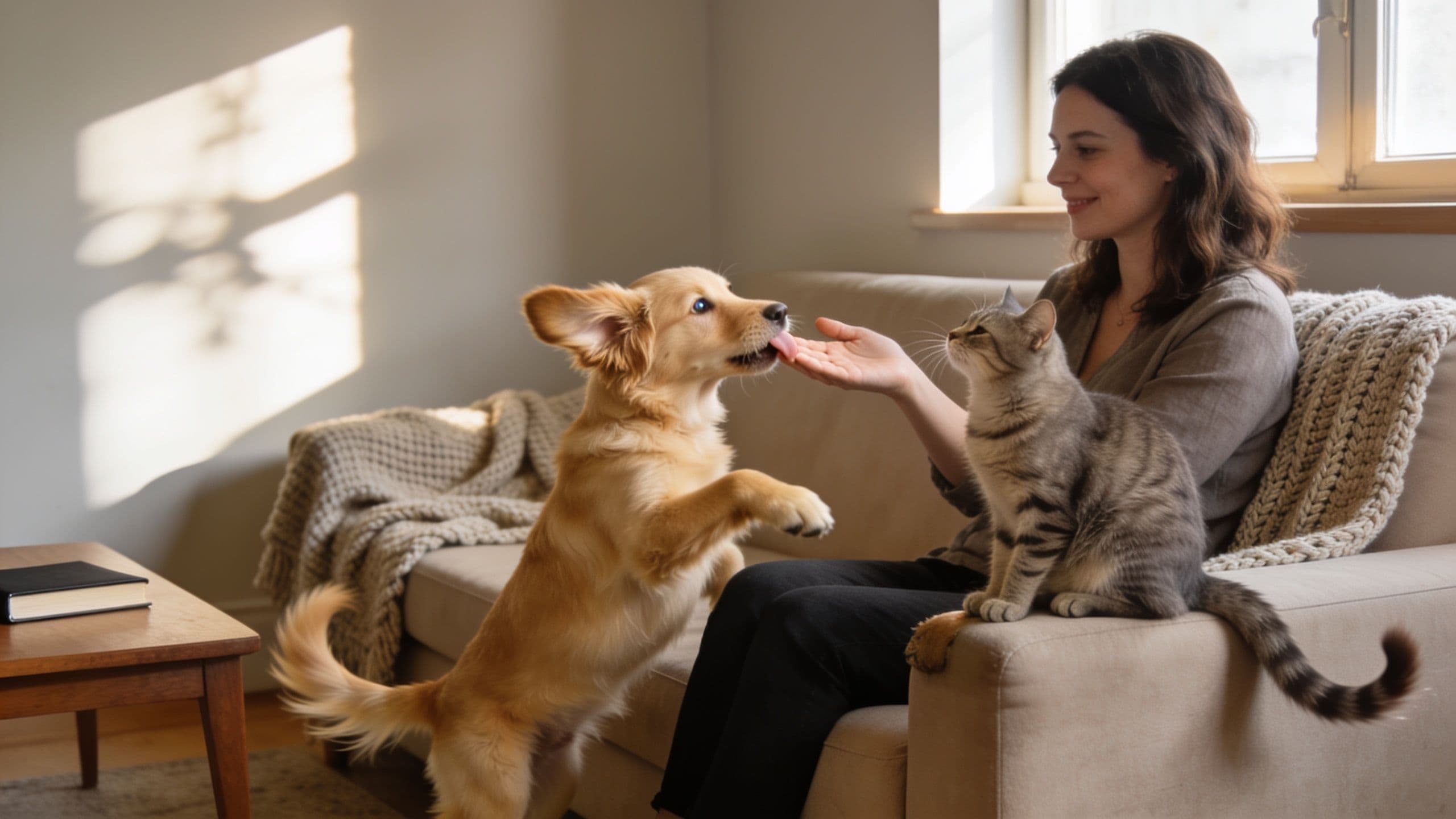
A dog and a cat can both be loyal, funny, affectionate companions, yet living with each often feels like joining a different social system. The contrast is not simply that dogs are friendly and cats are aloof. It is that dogs and cats tend to organize their relationship with humans in different ways, from how they ask for attention to how they handle routines, noise, space, and touch.
That is why a household with a Labrador often runs on one rhythm, while a household with a tabby runs on another. Neither species is inherently better at bonding. They just make companionship visible through different habits.
Dogs lean into shared life; cats often prefer parallel life
One of the clearest differences between dogs and cats is social style. Many dogs are strongly oriented around group activity. They tend to notice where their people are, what they are doing, and whether they can join in. A dog may follow someone from room to room not because it needs something urgent, but because being part of the action is the point.
Cats often bond just as strongly, but many do it with more selective timing. Instead of wanting to participate in every household movement, a cat may choose specific windows for closeness: sitting near a laptop in the evening, appearing at breakfast, or curling up nearby once the home gets quiet. The relationship can feel less performative and more negotiated.
This is why dog owners often describe their pets as eager, while cat owners describe theirs as discerning. A dog may treat your presence as an invitation. A cat may treat your availability as one factor among several, including comfort, mood, and whether the blanket is warm.
That difference shapes owner expectations. People used to dogs may misread a cat's independence as detachment, when it is often a different expression of security. A cat that naps alone all afternoon but appears every night on the sofa may be showing stable attachment, just not constant participation.
Communication: dogs broadcast, cats fine-tune
Dogs usually communicate in larger, easier-to-spot signals. Tail position, body posture, excited spinning, whining at the door, bringing a toy, or planting themselves in front of a person are all direct ways to say something is wanted right now. Over thousands of years of domestication, dogs have become highly responsive to human cues and unusually good at getting humans to notice them in return.
Cats communicate too, but often with subtler gradations. A slow blink, a brief head-butt, a flicking tail, ears shifting sideways, or a change in where the cat chooses to sit can all carry meaning. Vocalization varies widely by individual, but many pet cats also use meows strategically with humans more than with other cats.
The challenge is that people often interpret one species through the emotional grammar of the other. A wagging dog tail usually reads as positive engagement, though context still matters. A cat tail moving back and forth can signal irritation or high arousal rather than happiness. A dog rolling over may be inviting contact or showing deference. A cat exposing its belly is often a sign of trust, not necessarily an invitation to pet.
Mixed-pet households learn this quickly. The humans who do best are usually the ones who stop asking, "Why doesn't my cat act like my dog?" and start asking, "What is this animal telling me in its own style?"
Routine is where the contrast becomes impossible to miss
Daily life with dogs usually involves more overt structure. Walk times, bathroom breaks, training practice, active play, and social interaction often happen on a schedule that affects the whole household. Even small dogs can shape the day around outings and check-ins.
Cats tend to integrate into household life with less visible management, but they are not random. Many develop strong internal routines around feeding, play, window-watching, and rest. The difference is that the human role can feel less supervisory. A cat may entertain itself for long stretches, then become intensely engaged for fifteen minutes with a wand toy or an open cardboard box.
This is part of why dogs are often experienced as requiring participation, while cats are often experienced as requiring stewardship. With dogs, owners are usually co-actors in the day's events. With cats, owners are often facilitators who set up an environment the cat can move through comfortably.
There are practical exceptions, of course. Indoor cats need active enrichment, especially in small homes, and high-energy breeds such as Bengals can demand far more interaction than the stereotype suggests. Likewise, some senior or low-key dogs are perfectly content with a quieter routine. But in broad terms, dogs pull households outward into shared activity, while cats more often fold themselves into existing domestic patterns.
Trainability means different things for each species
People commonly say dogs are easier to train than cats. In one sense, that is true. Dogs are often more motivated by social praise, more willing to repeat tasks on cue, and more tolerant of structured practice. That makes obedience-style training more visible and more rewarding for humans. Sit, stay, come, loose-leash walking, and place work all fit well with canine social tendencies.
Cats can absolutely learn routines, cues, and tricks. Clicker trainers have shown this for years, and some cats readily learn to target, sit, spin, use puzzle feeders, enter carriers on cue, or come when called. But cats often demand a better bargain. If the repetition feels pointless, overstimulating, or badly timed, cooperation can evaporate.
That does not make cats unintelligent. It means motivation looks different. Many dogs are willing to engage because the interaction itself has value. Many cats engage when the interaction is clear, efficient, and worthwhile.
For owners, success also looks different. A well-trained dog may be expected to respond reliably in changing environments, including parks, sidewalks, and around guests. A well-supported cat may be one that tolerates nail trims, uses scratching posts, enters a carrier without drama, and has enough stimulation to prevent destructive boredom. Both outcomes reflect learning. They simply serve different forms of domestic life.
Affection is not the same performance, but it can be equally strong
The warmest misunderstanding in the cat-versus-dog conversation is the idea that affection must look the same to count. Dogs often make attachment obvious. They greet at the door, lean into legs, bring toys, seek petting, and watch their people closely. The emotional transparency is part of their appeal.
Cats are often more variable, but their affection can be deeply patterned. A cat that sleeps near your feet, waits outside the bathroom, touches your face with a paw at dawn, or sits in the same room without demanding engagement may be expressing closeness in a way that fits feline comfort. Many cats prefer proximity over handling, especially when overstimulation is a risk.
This is why some people feel instantly fluent with dogs and gradually literate with cats. Dog affection is often legible on first contact. Cat affection becomes clearer as you learn thresholds, preferences, and rituals.
Even greeting rituals differ. Dogs may burst into full-body celebration after a short absence. Cats may glance up, stretch, weave around ankles, then move on as if the reunion is complete. To a dog-minded person, that can seem underwhelming. To a cat-minded person, it is elegant efficiency.
The better fit often comes down to household rhythm
For many people, the most meaningful differences between dogs and cats have less to do with abstract personality and more to do with how a home functions. A dog often suits people who enjoy active participation, visible feedback, and a companion woven into errands, walks, visitors, and routines. A cat often suits people who appreciate quieter coexistence, environmental design, and a bond that builds through respect for autonomy.
That does not divide the world neatly into dog people and cat people. Plenty of households love both precisely because each species fills a different emotional and practical niche. The dog may bring momentum, comedy, and structure. The cat may bring calm, observation, and a kind of understated intimacy.
The useful takeaway is that dogs and cats are not opposites on a simple friendliness scale. They are different collaborators in domestic life. Dogs tend to turn companionship into a shared project. Cats often turn it into a refined, ongoing conversation. Once that difference clicks, both species become easier to understand and much more enjoyable to live with.
Safety & Scope
This article is for general informational purposes and does not replace professional advice for complex repairs or installations.
Frequently Asked Questions
+Are cats really more independent than dogs?
Often, yes, but independence does not mean lack of attachment. Many cats are comfortable spending time alone and managing their own rest and activity patterns, yet they still form strong bonds with people. Their attachment is often expressed through proximity, routines, and selective interaction rather than constant engagement.
+Why do dogs and cats show affection so differently?
Their social tendencies and communication styles differ. Dogs often use overt behaviors like greeting excitedly, leaning, licking, or seeking direct attention. Cats may show affection through slow blinks, head-butting, sleeping nearby, following at a distance, or choosing to sit close without wanting constant touch.
+Which is easier to train, a dog or a cat?
Dogs are generally easier to train for obedience-style tasks because they often enjoy repetition, social praise, and working closely with humans. Cats can learn cues and tricks too, but they are usually less tolerant of repetitive drills and more selective about motivation and timing.
+Can dog people learn to understand cats better?
Yes. The key is to stop expecting dog-like responses and start reading feline signals on their own terms. Paying attention to tail movement, ear position, body tension, preferred touch zones, and timing helps dog-oriented owners become much better at understanding what a cat is communicating.