A Calm Play Session Ends Better Than a Wild One
The last two minutes of play often shape the next half hour. A calmer finish helps dogs, cats, and small pets settle more easily, reduces post-play chaos, and makes play feel rewarding instead of overstimulating.
Avery writes about trends, platforms, and strategic shifts in pets & animal lifestyle, with attention to what matters in practice.
For many pets, the most important part of play is not the chase, tug, pounce, or sprint. It is the ending. A session that peaks hard and stops abruptly can spill into barking, zoomies, nipping, furniture-launching, or relentless pestering for more. A session that tapers down tends to produce the opposite: a pet that can shift gears, settle, and move on with the day.
That matters in real homes, where play is often squeezed between work calls, school pickups, dinner prep, or bedtime. If every game ends with a dog ricocheting through the hallway or a cat stalking ankles for the next twenty minutes, the issue is not necessarily that the pet needs less fun. More often, the finish needs better pacing.
The ending sets the emotional tone
Pets do not move from high arousal to true calm in a single beat. During active play, movement, anticipation, and rapid decision-making all push excitement up. When the game ends at the exact moment energy is highest, that momentum has to go somewhere.
In dogs, that can look like grabbing sleeves, barking at people, stealing cushions, or pestering housemates. In cats, it may show up as hallway ambushes, darting from room to room, or swatting at moving feet. Small companion animals can become skittish, hyperactive, or unusually restless after intense handling or stimulation.
Owners often read this as a sign that the pet wants more play. Sometimes that is true. But just as often, the pet is over-activated rather than under-served. The body is still in motion, the brain is still chasing the last burst of stimulation, and there has been no clean bridge into a quieter activity.
A smoother finish helps because it teaches a complete pattern: engage, enjoy, slow down, settle. That full arc is easier on the household and, over time, easier on the pet too.
The moment play starts to tip too high
The best time to think about the ending is before things get frantic. Once a pet is fully over threshold, asking for calm becomes much harder.
Common signs that a dog is getting too wound up include:
Taking toys harder and harder
Ignoring familiar cues it usually knows
Jumping onto people instead of staying with the game
Barking sharply between repetitions
Snatching, mouthing, or grabbing clothing
For cats, warning signs often look different but mean the same thing:
Movements become less targeted and more explosive
The cat cannot pause between pounces
Ears flatten or tail lashes during play
The cat leaves the toy and redirects onto hands, feet, or nearby pets
With rabbits, ferrets, guinea pigs, or other small pets, overstimulation may show up as rapid darting, avoidance, rough handling responses, or difficulty returning to normal exploring or feeding behavior.
The practical takeaway is simple: do not save the wind-down for after the pet is already wild. Start tapering when enthusiasm is still high but manageable.
How to build a finish that actually works
A calm ending does not mean making play boring. It means designing the final minute or two so excitement can descend instead of crashing.
Use a short cool-down, not a hard stop
If you are playing fetch with a dog, make the final few retrieves shorter and easier. Roll the ball instead of launching it long distance. If you are playing tug, reduce intensity, slow your movements, and ask for a couple of simple releases between rounds. If your cat is chasing a wand toy, move from long sprints and aerial jumps to slower ground-level stalking and one or two satisfying catches.
This is the same principle human athletes use after hard effort. The body and brain handle transitions better when there is a downshift.
End with a species-appropriate calming activity
Different animals settle through different behaviors.
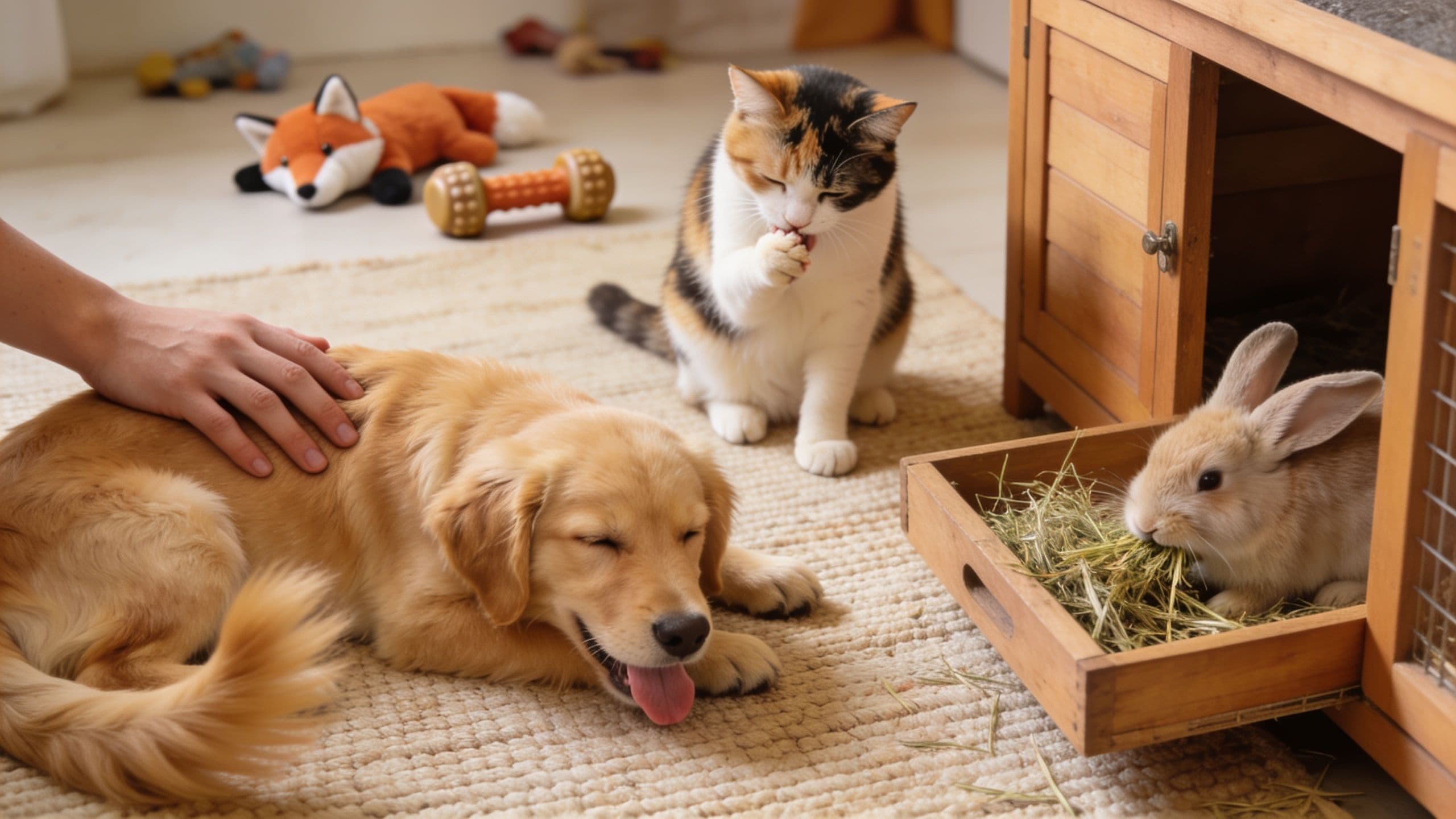
For dogs, sniffing, licking, chewing, and easy foraging are especially useful. A few pieces of kibble scattered in the grass, a lick mat, a stuffed toy, or a calm chew can help redirect energy into a lower gear. Sniffing walks are often a better post-play follow-up than another burst of running.
For cats, the best ending usually includes a successful catch followed by something that completes the hunt sequence, such as a small treat or meal. Many cat behavior professionals recommend ending wand play this way because it lets the cat move from stalk and chase into capture and consume, rather than being left hanging in pursuit mode.
For small mammals, a good transition may be quiet exploration, hay, a favorite chew, or returning to a familiar low-stress setup instead of continuing handling after excitement peaks.
Create a reliable final cue
Pets benefit from patterns. A simple phrase such as "all done," paired with the same gentle routine each time, can make endings more predictable. The cue itself is not magic; what matters is consistency. If "all done" is always followed by a sniffy scatter, a chew, a meal, or a rest period, many pets start learning that the game is over and the next activity is safe and satisfying.
That predictability can reduce the frantic demand for one more throw, one more chase, one more pounce.
Why post-play chaos gets mistaken for a training problem
Not every rough ending is disobedience. Sometimes owners accidentally create a cycle where the most intense behavior gets the biggest payoff.
A dog that barks wildly after fetch may get extra throws because the owner assumes the dog still has energy to burn. A cat that races around knocking things over may get another laser session or more teasing movement from people. The pet learns that escalating works.
The problem is common with high-drive dogs and chase-oriented cats, but it can happen with almost any pet that finds arousal rewarding.
The solution is not punishment for being excited. It is better structure:
Keep the most intense phase short
Watch for rising loss of control, not just obvious exhaustion
Build a cooldown into the game itself
Offer a quiet follow-up activity before chaos starts
Be consistent about when play ends
This tends to work better than waiting for a pet to spiral and then trying to enforce calm from scratch.
The right finish depends on the pet in front of you
No single formula fits every animal. Breed, age, health, history, and play style all matter.
A young retriever or herding dog may need very intentional pacing because movement itself is so rewarding. Fast, repetitive ball throwing can push some dogs into a state that looks less like healthy play and more like compulsion. By contrast, a shy older dog may benefit from shorter, softer sessions with more pauses and less intensity overall.
Cats vary just as much. Some adore explosive chase games and can still settle well afterward if the session includes a proper capture and food reward. Others become visibly dysregulated if toys move too fast or if the game goes on too long. For many indoor cats, several short sessions with clean endings work better than one huge energy spike.
Small companion animals often need owners to think less about "wearing them out" and more about keeping interaction predictable and low-stress. What looks fun to a human can become overwhelming quickly for prey species.
The easiest way to tailor your approach is to look at what happens in the ten minutes after play. If your pet can drink water, groom, sniff, chew, eat, rest, or disengage calmly, the finish is probably working. If the pet launches into chaos every time, the session may be ending too hot.
A better game is one your pet can recover from
There is a popular idea that good play should leave a pet completely spent. In practice, that is not always the most useful goal. A successful play session is not just one that burns energy. It is one that leaves the pet emotionally organized enough to return to normal life.
That may mean stopping sooner than you used to. It may mean replacing the final high-speed chase with a sniff break, a chew, or a handful of treats hidden in a towel. It may mean noticing that your cat needs the toy to slow down before the session ends, not after. And it may mean accepting that more intensity is not always better enrichment.
The strongest play routines do two jobs at once: they satisfy natural behavior, and they make the next part of the day easier. When the ending is calm, the whole session gets better.
Safety & Scope
This article is for general informational purposes and does not replace professional advice for complex repairs or installations.
Frequently Asked Questions
+Why does my dog get crazier after playtime?
Dogs often get wilder after play when the session ends at peak excitement instead of tapering down. Their arousal stays high, so the energy spills into barking, jumping, grabbing, or zooming. Shorter intense play, followed by a calm transition like sniffing, licking, or a chew, usually works better than an abrupt stop.
+How should I end a cat play session?
A good cat play session usually ends with slower toy movement, a final successful catch, and then a small treat or meal. That helps complete the stalk-chase-catch sequence and makes it easier for the cat to settle instead of staying keyed up and looking for something else to hunt.
+What is the best way to calm a pet after active play?
Use a brief cooldown and then switch to a naturally calming activity. For dogs, try sniffing, a lick mat, a chew, or scattered food. For cats, offer a final capture and a small food reward. For small pets, return them to a quiet, familiar setup with appropriate enrichment. Consistent routines and a clear end cue also help.