A Better Setup for Pets Who Camp Under the Dining Table
When a pet keeps choosing the space under the dining table, the appeal is usually simple: cover overhead, a clear view outward, and steady access to the family without being in the middle of the traffic. The best replacement keeps those same qualities while making the room easier to use.
Avery writes about trends, platforms, and strategic shifts in pets & animal lifestyle, with attention to what matters in practice.
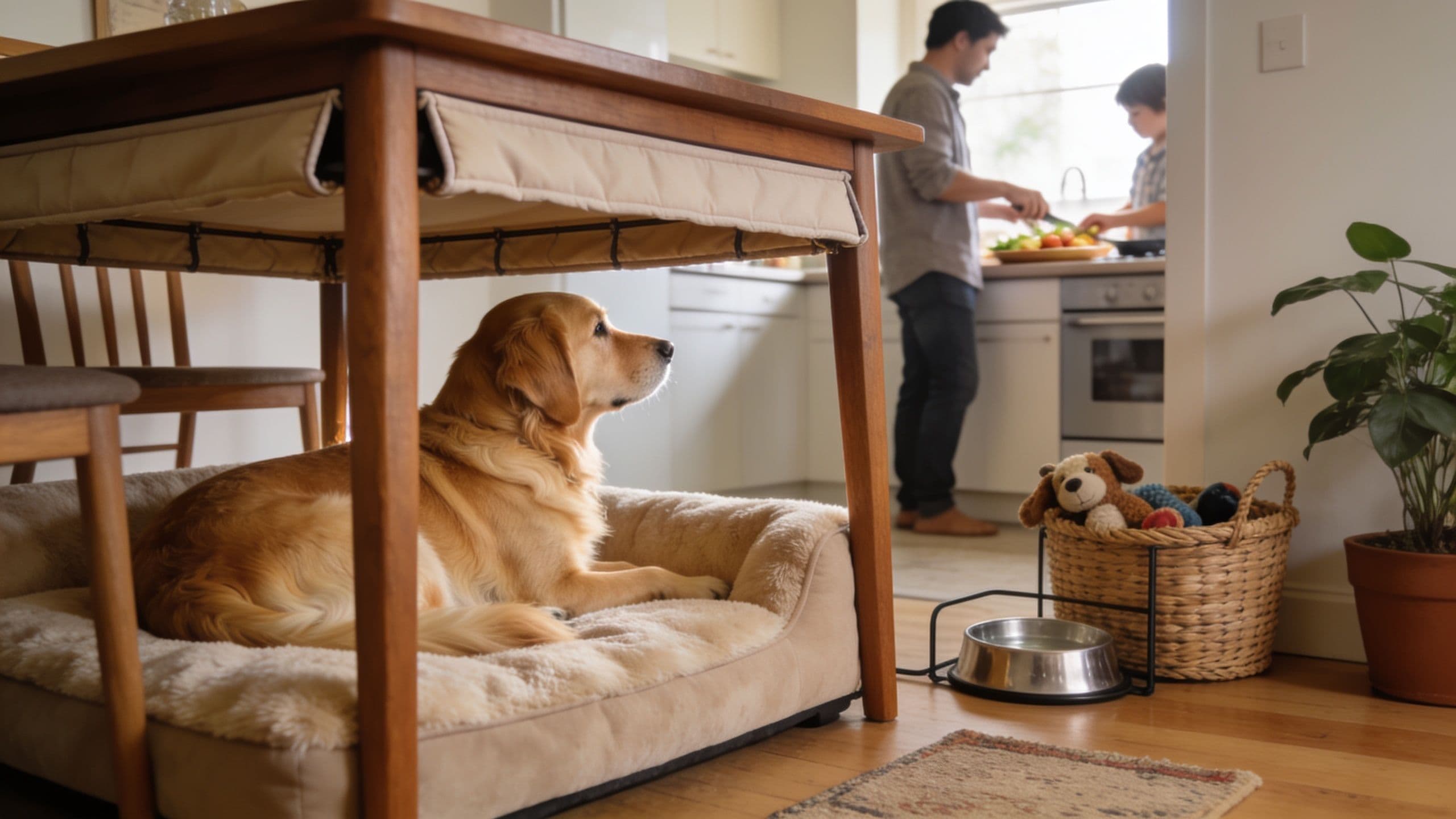
Some pets could have the run of the house and still pick the same square of floor beneath the dining table. That choice is rarely random. Under-table spots combine two things many animals value at once: shelter and social access. From that position, a dog or cat can stay close to the family, monitor movement, and avoid the bustle of feet, chairs, and hands reaching in from every direction.
For owners, the habit can be charming until it starts to interfere with meals, hosting, cleaning, or safe movement around the room. The smartest fix is not to push the pet into a completely different kind of bed. It is to recreate the qualities that made the table attractive in the first place.
Why the dining table works so well
The space under a table offers a specific kind of comfort. It is not fully hidden like a crate with the door closed, and it is not exposed like a bed placed in the center of the kitchen. It is a semi-sheltered zone.
That matters because many pets do not want isolation. They want a protected front-row seat.
A few features make under-table living especially appealing:
Partial enclosure: A tabletop above and chair legs around the sides create a sense of cover without cutting the pet off from the room.
Sightlines: Most animals can still see people entering, leaving, sitting down, and passing through.
Predictable activity: Mealtimes, homework, conversations, and evening routines often happen around the table. Predictability is calming.
Low social pressure: A pet can be near people without being the center of attention.
Cool, stable flooring: In many homes, the dining area has wood, tile, or other surfaces that stay cooler than upholstered furniture or sunny windows.
Behaviorally, this makes sense. Dogs often seek places where they can rest while staying connected to household rhythms. Cats, too, frequently favor spaces that offer both concealment and observation. The attraction is less about "hiding" than about controlling exposure.
What the habit says about your pet's comfort style
A pet under the table is not necessarily anxious, antisocial, or poorly trained. Often the habit points to a preference: being close without being crowded.
That distinction helps owners make better choices. If a dog leaves the sofa to lie under the table while guests talk nearby, the dog may simply prefer a spot with overhead cover and clearer boundaries. If a cat disappears under dining chairs during a busy evening, that may be a practical choice rather than a red flag.
The setup also gives pets a way to regulate interaction. They can watch family life, decide when to engage, and retreat half a step if the room gets noisier. For animals that are social but easily overstimulated, that balance can be ideal.
This is why some popular pet beds fail. An open cushion dropped in the middle of the room may be soft, but it removes the very features the animal was seeking. Likewise, a bed hidden in a back bedroom may be too isolated. Comfort is not only about padding; it is about position.
Build a better equivalent, not a completely different destination
If you want your pet out from under the dining table, create an alternative that preserves the same logic.
1. Place the new spot near the social zone
Distance matters. A covered bed in a laundry room is not a realistic substitute for a table-adjacent refuge during dinner. Start within a few feet of the dining area, kitchen threshold, or family-room edge—where the pet can still see and hear the household.
Good options include:
A covered pet bed beside a sideboard or buffet
A low-profile mat along a bench or wall near the table
A crate left open with soft bedding, positioned to face the room
A quiet corner bed with one or two sides protected by furniture
For cats, a chair with a draped blanket can create a simple cave-like zone. For dogs, a bolstered bed placed beside a wall often works better than a flat pad in open floor space.
2. Keep the overhead or side protection
The biggest mistake is offering a replacement with no sense of shelter. If the table is attractive because it creates a roofline and perimeter, mimic that.
Try:
Beds with a hood or canopy
Placement under a console table, bench, or desk with enough clearance
A bed tucked between substantial furniture pieces
A crate cover on three sides, with the front open
The goal is not to make the pet disappear. It is to give them visual boundaries.
3. Preserve the outward view
A secure spot still needs sightlines. Avoid pushing the bed into a dead corner where the pet cannot monitor the room. Many animals relax better when they can see approach paths, family members, and the general flow of activity.
Think of the ideal setup as sheltered observation, not hidden storage.
4. Make traffic patterns safer for everyone
If your pet currently lies directly under chair legs or in the path between the kitchen and table, safety should shape the redesign. Shift the new resting zone just outside the highest-traffic lane. That keeps the pet close to the action without putting them underfoot.
This is especially important for:
Large dogs in narrow dining spaces
Senior pets that are slower to move
Households with children carrying plates or drinks
Homes where guests may not notice a dark-coated pet on the floor
Sometimes the best fix is surprisingly small: moving the resting spot 18 to 24 inches to the side can preserve the social benefit while clearing the main path.
Training the new spot without turning it into a battle
Once the setup is right, the transition is usually easier. If the new bed still offers proximity, cover, and visibility, many pets will test it on their own.
You can speed that up by pairing the spot with calm, predictable rewards:
Toss a treat onto the bed as meals begin
Offer a chew or lick mat there during family dinner
Praise quietly when the pet settles in the new location
Repeat at the same times each day so the spot gains routine value
Avoid dragging, scolding, or repeatedly shooing the pet away from the table. That can turn the whole dining period into a contest while doing nothing to make the alternative more appealing.
For dogs, cue-based stationing can help. A simple "bed" or "place" cue, taught gradually and reinforced during mealtimes, gives structure to the behavior. For cats, environmental design matters more than formal training; comfort, location, and consistency do most of the work.
If your pet strongly resists the new spot, compare it honestly with the old one. Is it too exposed? Too far away? Too warm? Too noisy? Most failures come from missing one of those details.
When the table spot is perfectly fine to keep
Not every under-table habit needs correcting. If the space is safe, does not block movement, and helps your pet stay calm during busy family time, the simplest solution may be to respect the preference.
That is especially true when the pet:
Settles there voluntarily and relaxes
Can get in and out easily
Is not guarding the space
Is not at risk from chair movement or falling food hazards
Uses the area during gatherings but also rests comfortably elsewhere at other times
In some homes, a dedicated mat under one side of the table is the practical compromise. It acknowledges the pet's chosen micro-habitat while reducing mess and clarifying where they should settle.
What deserves closer attention is a sudden change. If a normally social pet starts spending much more time hiding under furniture, or seems tense, reluctant to come out, or unusually sensitive to noise, that may signal discomfort with the environment rather than a simple preference. In that case, the issue is broader than bed placement.
The key takeaway is straightforward: pets that camp under the dining table are often asking for cover plus company. Give them a nearby spot with boundaries, a good view, and a little distance from the busiest feet, and the room usually works better for everyone.
Safety & Scope
This article is for general informational purposes and does not replace professional advice for complex repairs or installations.
Frequently Asked Questions
+Why does my pet always sleep under the dining table?
Many pets choose the dining table because it offers partial cover, clear sightlines, and proximity to the family without requiring direct interaction. It functions like a protected social space rather than a full hiding place.
+Do pets prefer covered resting spaces?
Many do, especially when the room is active. Covered or semi-enclosed spaces can help pets feel secure while still letting them observe what is happening. Preference varies by animal, but overhead cover and side boundaries are common comfort features.
+How can I give my pet a secure spot during family meals?
Set up a bed or mat near the dining area, not far away, and choose a location with some shelter and a view of the room. Covered beds, open crates, or a cushioned spot beside a bench or wall often work well. Reward calm settling there during meals so the new spot becomes part of the routine.