How Cat Whiskers Help Them Read a Room
Cats do not move through the house by guesswork alone. Their whiskers help them judge space, detect nearby obstacles, and make fast decisions about bowls, doorways, furniture gaps, and hiding spots.
Jordan specializes in turning complex pets & animal lifestyle topics into clear, useful explainers for everyday readers.
Cats often look effortless indoors, but that smooth movement is built on constant sensory checking. When a cat pauses at the edge of a shelf, turns away from a narrow gap, or seems strangely picky about a food bowl, whiskers are often part of the explanation. Far from being decorative, they are precision tools that help cats judge space, detect changes around their face, and move with confidence through familiar rooms.
Whiskers are built for close-range spatial awareness
A cat’s whiskers, or vibrissae, are thicker and more deeply rooted than ordinary fur. They are connected to follicles surrounded by nerves, which makes them highly sensitive to small movements and contact. The long whiskers on either side of the muzzle get the most attention, but cats also have shorter whiskers above the eyes, on the chin, and on the backs of the front legs.
That setup gives cats a remarkably detailed read on what is happening nearby. Whiskers do not function like little measuring tapes in a literal sense, but they do help a cat assess whether an opening feels passable, whether an object is too close to the face, and whether the body can move through a space without scraping or getting stuck.
This matters most in the zone where a cat is actively deciding what to do next: squeeze through, jump up, back away, turn sideways, or choose another route. In bright daylight, low light, or a dim hallway at night, whiskers add information that vision alone cannot provide.
Why cats hesitate at specific gaps, corners, and obstacles
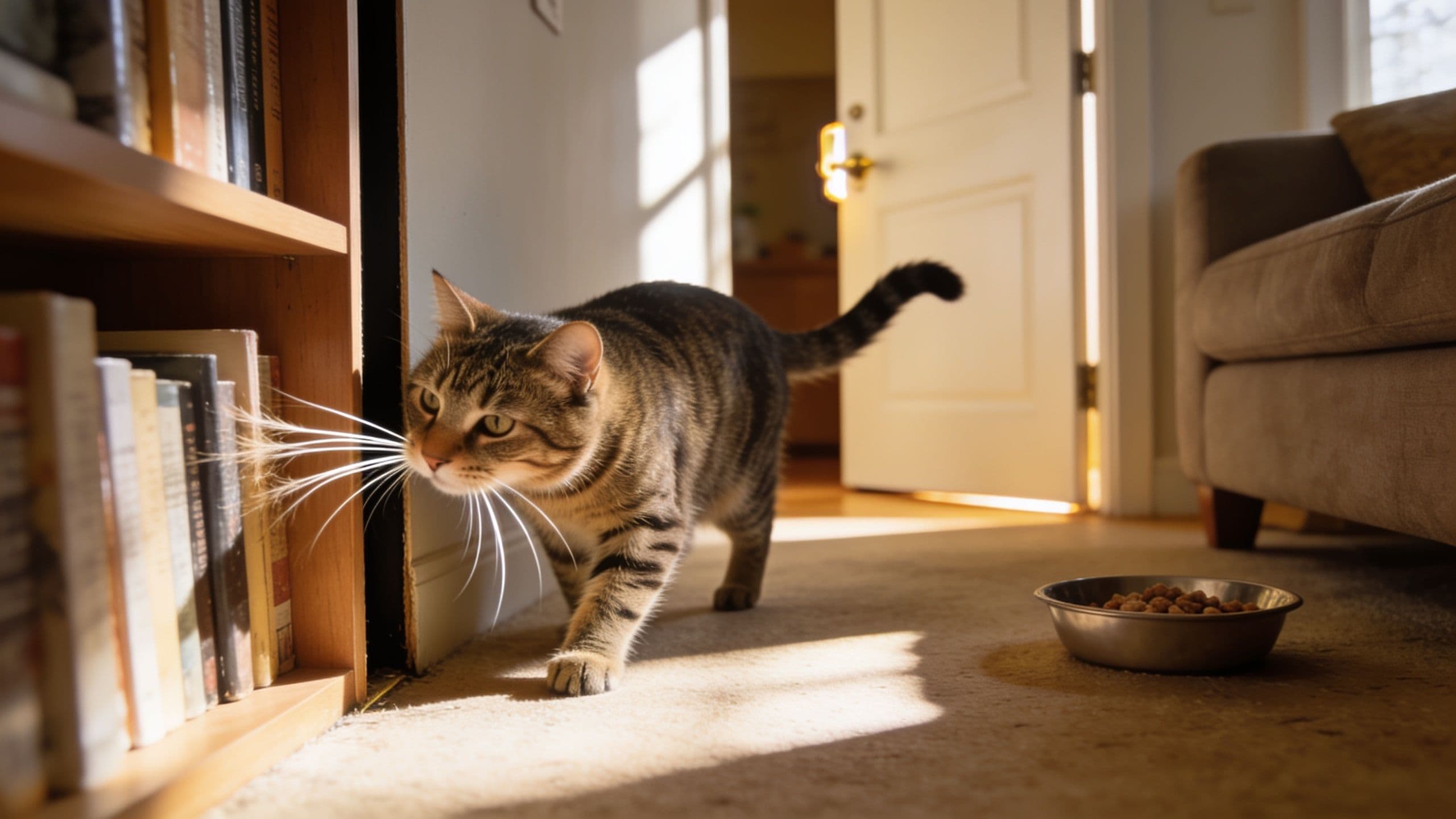
People often notice whisker-based decision-making in very ordinary parts of the home. A cat that confidently springs onto a sofa may still stop short at a tight gap between a chair and the wall. Another may inspect the side of a bookcase before attempting to pass behind it. These pauses can look fussy, but they are usually practical.
Doorways and furniture gaps
Cats tend to test tight spaces with their heads first. The whiskers around the muzzle can brush the edges of an opening and give feedback before the rest of the body commits. That is one reason many cats seem to "check" a gap before moving through it. If the space feels too close around the face, the cat may decide it is not worth the effort, even if it could technically squeeze through.
This is also why a cat may prefer one route through a room over another. A wide, clean path between the sofa and coffee table feels easier than a cluttered route lined with bags, shoes, or stacked boxes that push against the whiskers.
Moving in low light
Cats see well in low light, but whiskers still play a useful supporting role when visibility is limited. They help a cat detect nearby surfaces and airflow changes around objects, especially when maneuvering close to walls or under furniture. That contributes to the uncanny way many cats can travel confidently through a dark room they know well.
Corners and elevated spaces
Whiskers also matter when a cat is turning in a tight spot or landing in a narrow area. A shelf, windowsill, or the space behind a curtain rod may look simple to a person, but for a cat, the face has to feel safe before the body settles. If the whiskers are pressed awkwardly against a wall or object, the space may be rejected even if it seems cozy from a human perspective.
The hidden reason some bowls and hideouts get rejected
A surprising number of everyday cat preferences make more sense once whiskers are part of the picture.
Food and water bowls
Deep, narrow bowls can repeatedly press against the whiskers while a cat eats or drinks. Many owners describe this as whisker discomfort or whisker fatigue, though the term is used more casually than scientifically. What is clear in practice is that some cats strongly prefer shallow, wide dishes that let the whiskers stay more neutral.
That can show up as odd feeding behavior: eating only from the center of a bowl, pulling food onto the floor, pawing at kibble, or showing more interest in a plate-like dish than a standard pet bowl. Brands that make broad, shallow feeding dishes market them specifically around feline comfort, and for some cats the difference is noticeable.
Carriers, cubbies, and covered beds
A carrier might be large enough by measurement but still feel uninviting if the entrance is narrow or the interior forces the whiskers against the sides. The same goes for trendy enclosed cat beds, storage-cube hideouts, or decorative tunnels that look appealing to humans but create constant facial contact.
If a cat avoids a hideaway that seems soft and secure, the problem may not be the material or location. It may simply feel too tight around the face and shoulders. Cats usually prefer spaces that offer both shelter and an easy sense of exit.
Water fountains and tight corners
Some cats drink more readily from fountains or wide water stations because the setup gives them more room around the muzzle. Placement matters too. A bowl pushed into a corner can force awkward approach angles, especially if whiskers brush the wall while the cat is trying to drink. A few inches of open space can make a setup feel much friendlier.
Whiskers influence confidence as much as comfort
Whiskers are not only about avoiding bumps. They can shape how secure a cat feels in a room.
A cat that has clear pathways, roomy resting spots, and easy access to food and water often moves with more ease. A cat faced with cramped routes, clutter, or equipment that presses on the whiskers may seem cautious, irritable, or oddly selective. That does not mean whiskers explain every behavioral quirk, but they are part of the sensory backdrop that affects a cat’s choices.
This helps explain why two cats can react differently to the same home layout. One may happily weave through chair legs and baskets. Another may avoid those areas entirely and stick to open routes along the edge of the room. Personality matters, but so does how each cat processes close-up space.
It is also one reason whisker trimming is such a bad idea. Whiskers are not excess fur. Cutting them removes an important source of sensory information and can make a cat less sure-footed and less confident in everyday movement.
Small home changes that make navigation easier
Most whisker-friendly adjustments are simple and do not require turning a home into a minimalist cat playground.
Start with feeding stations. Wide, shallow bowls or plate-style dishes are often more comfortable than deep cups. Keep water and food where the cat can approach from more than one angle rather than wedging them into tight corners.
Look at your cat’s common routes. If there is a habitual path from the living room to a favorite perch, clearing a little extra space around that route can reduce hesitation. This is especially useful in homes with lots of stools, baskets, chargers, or small objects at face level.
Be selective about hideouts. A good cat bed or cubby should feel sheltered without pinching the whiskers at the entrance. Carriers should also offer enough room for the cat to enter and turn without brushing hard against every side.
Finally, pay attention to what your cat is already telling you. If they avoid one bowl, ignore a particular cubby, or consistently choose the wider side of a room, that pattern is useful information. Cats tend to repeat what feels physically easy and avoid what feels awkward.
Whiskers help explain many of those tiny decisions. They are part of the reason cats can thread through daily life so neatly, and part of the reason they sometimes refuse things that seem perfectly acceptable to us. Once you notice whisker logic, a lot of feline behavior around the house stops looking mysterious and starts looking smart.
Safety & Scope
This article is for general informational purposes and does not replace professional advice for complex repairs or installations.
Frequently Asked Questions
+Do whiskers help cats measure spaces?
Yes, in a practical sense. Whiskers help cats judge whether openings, gaps, and nearby objects feel safe to pass. They are not rulers, but they provide detailed sensory feedback about close-range space.
+Why does my cat avoid certain bowls or hideouts?
A bowl may be too deep or narrow, causing repeated whisker contact while your cat eats or drinks. Hideouts, carriers, and enclosed beds can also feel uncomfortable if the entrance or interior presses against the whiskers.
+Can whiskers affect how confident a cat feels in a room?
Yes. Whiskers support navigation and spatial awareness, so cramped pathways, clutter, or tight objects around the face can make a cat more hesitant. Clear routes and roomier setups often help cats move more comfortably.